Friday, August 26, 2005

Summer reading


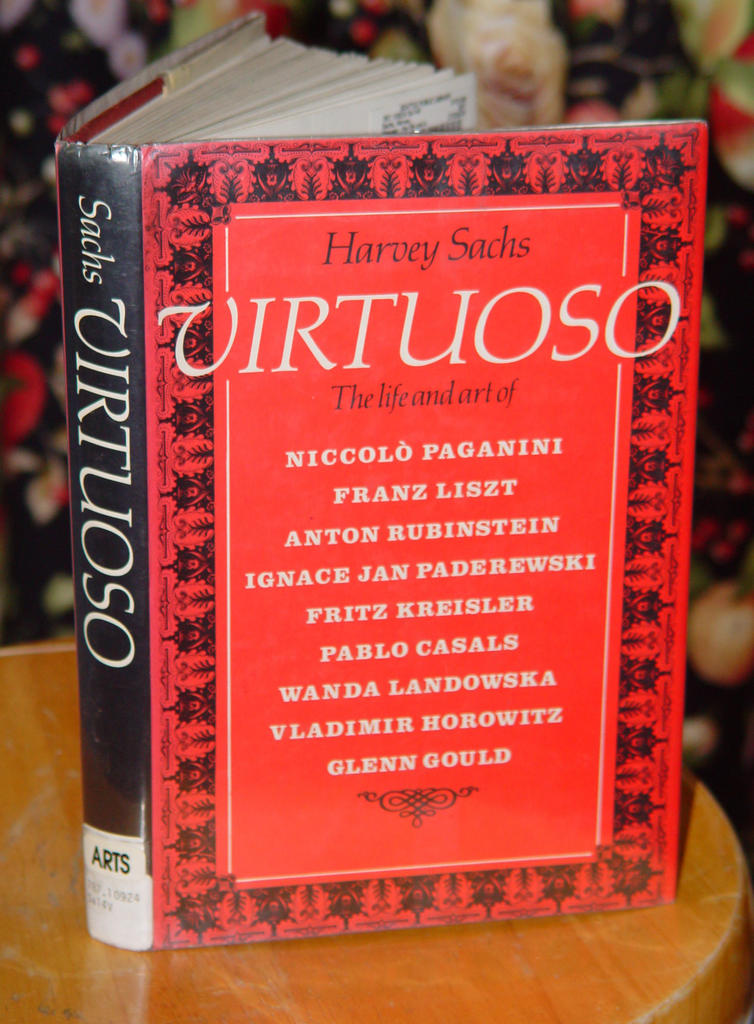
In addition to a rather large number of books on music in our bookcases, my wife brings other ones home from the Seattle Library system. Recently I have read ‘Music and the line of most resistance’, by Artur Schnabel, and ‘Virtuoso’, by Harvey Sachs. They were written 40 years apart, in 1942 and -82, respectively.

Old books often open a window to a different era and offer the reader an opportunity to see life from a very different perspective from today. In music, some problems have remained the same: Schnabel writes about music critics and art journalism at length and states:
‘Great men are as rare among the critics as they are among the musicians or any other group, but the consequences of not being great are not the same for critics as they are for musicians who appear in public. Only the musicians are publicly criticized.’ The writer laments the disappearance of amateurs which he, to a point, blames on the radio and the phonograph. ‘It follows that the amateur, as I define the term, always dwells on a plane higher than that of a professional who never produces, and is never keen to produce, what may be classified as art. Not every musician is an artist.’ Schnabel has other refreshing opinions as well: ‘To correct the misconception concerning “virtuosity,” which (I must emphasize once more) must also be completely mastered for the performance of inwardly originated music, although it is generally related to the external (which is about all there is to the other species), Walter J. Turner, the English poet, has suggested giving to the the so-called “virtuoso” a new name. The name is “trashoso”—which would precisely express what is nowadays expected from the virtuoso.’

The other book has short biographies with comments of nine famous instrumentalists, from Niccolò Paganini to Glenn Gould. Right now I’ll stick to ‘The life and art of Fritz Kreisler’. In 13 pages (plus a few for pictures) Sachs manages to spin a fascinating tale of probably the greatest artist violin playing has ever seen. Father Kreisler was the family physician of Sigmund Freud, who couldn’t quite understand why young Fritz was taken by his mother, at the age of 10, to Paris to study. Massart, himself a pupil of Kreutzer, wrote that although he had been ‘the teacher of Wieniawski and many others…little Fritz will be the greatest of them all.’ Another interesting detail is that Kreisler auditioned for a position in the Vienna Hofoper Orchestra (also known as the Vienna Philharmonic) but was not accepted. That tells you something about the fairness of auditions even back then! The author correctly points out that Kreisler’s name should not be used to symbolize sentimentality or schmalz. ‘The recordings he made are evidence enough that such notions are largely groundless.’

A well-known fact is that Fritz never liked to practice; he considered it a bad habit. A violinist friend of my father’s occupied a room next to the master’s during a mid-1930 tour to Finland. For three days the poor man had his ear glued to the wall, as he was determined to find out the secret of Kreisler’s artistry, from the way he practiced. Only on the third day, just before the concert, did the maestro take out his violin: he tuned it and put it back in the case. My dad used to tell me how upset this friend was; on a tight student budget and during the depression years, that certainly wasn’t money well spent.

Monday, August 22, 2005

Finns in the News

My countrymen have shown up in the news during the past week. Finland’s former president Matti Ahtisaari brokered a truce agreement between Indonesia and Free Aceh movement (GAM) which was signed August 15th. Aceh was the area hardest hit by the December tsunami of last year, with 130,000 casualties. GAM has been fighting for independence from Indonesia for almost 30 years. The new agreement calls for more autonomy but leaves the area as part of that nation. Another Finn is there overseeing the collecting of firearms and other weapons. Sometimes it takes a great tragedy for people to understand that peace is the best and only solution.

Now to sports: Helsinki hosted the track and field World Championships this month. Mother Nature wasn’t in her most co-operative mood and many events had to be postponed due to rain and storms. At the same time an American made helicopter from Tallinn, Estonia, crashed into the Gulf of Finland, killing all 14 abroad, during what was supposed to be a regular commercial 15-minute hop to Helsinki. Just yesterday, a Finnish Formula 1 driver Kimi Räikkönen won the inaugural
Turkish Grand Prix. I watched him win the Canadian one in June on Finnish television. While he may not be a rocket scientist, he sure knows how to drive and race.

Today’s New York Times has one of the
best reviews the Mostly Mozart Festival has ever received. The resident orchestra was conducted by Minnesota Orchestra’s Osmo Vänskä, whom I remember as a clarinetist and starting Kapellmeister in Finland 30 years ago. Obviously something remarkable took place in Avery Fisher hall this past weekend, as the orchestra used to be known more or less as a pick-up group. ‘Perhaps the most interesting aspect of the growing fascination with Mr. Vanska is that it is based entirely on his musicianship. Now in his early 50's, and given to energetic podium gestures that are often graceful though occasionally slightly clunky, he is not a picture of conductorial glamour. What Mr. Vanska does on the podium, though, is extraordinary, and on Saturday evening he made Mostly Mozart's resident freelance band sound like a world-class ensemble.’ Wow. I’m happy for the orchestra and Mr. Vänskä. Perhaps all his experience with rather small Finnish orchestras and in Lahti in particular, have given him a perfect know-how as to what a classical orchestra needs to excel.


At some later time I’ll write about a comical experience I had touring with the Lahti orchestra when I was just 16.

Sunday, August 14, 2005

Excuse me

When I first heard Michael Rabin perform during the Sibelius Week in Helsinki, prior to his concerto the festival's manager came out on stage. An announcement was made: Mr. Rabin's sister has suddenly died that morning but the soloist would nonetheless go ahead with his performance. All the older ladies in the audience took out their handkerchiefs and cried. I, too, was touched. A couple years later I heard Rabin again, this time in a smaller town in this country. The same story was repeated and I smelled a rat. Later I learned that there was no sister to start with.

Although it is not common for instrumentalists to make excuses, that does happen. A violinist showed up with a bandaged finger, very noticeable to the audience all the way to the last seat on the top balcony, and ended up with reviews which talked about her ‘injury’ rather than playing. Another one insisted on sitting on a stool, as a sore back is not as visible as a taped digit. What about orchestral players? When was the last time you heard an announcement that the principal oboe was going to play the evening concert, in spite of his hemorrhoids, or something to that effect? I do remember a principal string player being wheeled to the stage and off, even after the injury had healed. Once offstage she would hop off the wheelchair and walk normally.

Singers, in opera particularly, are another story. Of course the vocal cords are unpredictable, but that doesn’t account to the fact that during the course of an opera production the audience gets told time after time that Ms. Prima Donna or Mr. Helden Tenor are suffering from this and that, thus their voices are perhaps not in top shape but yet they insist on singing. Seldom is this evident in the performance, however, but conveniently this puts the singers in a taboo category: a critic or a mere mortal listener cannot possibly be critical of faulty intonation or anything else since the performer has such a ‘valid’ excuse. What would happen if listeners would demand their money back when performers admitted they were not doing their best? That would be fair after all, wouldn’t it? Or at least partial refund should take place. I bet those announcements before the start of a show or an act would be far less frequent.

Perhaps concerts, opera and ballet performances would become more interesting if there was a program insert for each show, indicating which performers were not in top shape, and for what reason. We could have a color coded or a point system for different levels of threat to a perfect performance. At the end of the year the points would be tallied and the averages published. A musician, dancer or even a conductor could get a bonus based on this. Question is: how much does a toothache affect one’s ability? What about a chronic condition, such as obesity, or just being seriously unhappy with one’s colleagues, not to mention having something stuck up the rear end?

Wednesday, August 10, 2005

The Better Half

This post is by my wife Marjorie -

Today, while walking and listening to my husband's recording of "Russian Easter Overture" I came home insisting to share an entry on Ilkka's blog. I think a wife deserves that much, don't you? We have lived through a traumatic and sad year but have grown all the wiser and closer for having survived our crisis together.

My first encounter with Ilkka Talvi took place in a chamber orchestra in Los Angeles. I will never forget how mystified and intrigued I became while listening to a violin solo that he performed during a concert. Who was this quiet, humble man that sounded like a beautiful voice from the past? Since I had been brought up on and practically fed Heifetz and Kreisler recordings in my youth, I immediately recognized that this dark, Finnish violinist played with a sound reminiscent of a bygone era. I wanted to know him...KNOW him. I pathetically inched my way close to him to say, "Gee, you play so beautifully". His reaction, ever so typical of my Ilkka was, "So what?" He has always failed to take compliments well and I doubt will ever be at ease with flattery.

So, we did get to know one another well, and in the process have created a life in music and two fantastic daughters. As trying as life can be, and as unforgiving, I feel it an honor to share my life with one who is so remarkable, yet humble. Ilkka, a shy, sensitive man, has not always received the recognition or acknowledgement that he's justly deserved. I am in part writing this for all those who care to know, that I believe there are a few among us who are unsung heroes, my husband included. They unobtrusively perform their tasks and duties so well, yet with such humility, that they go unnoticed and are not applauded for their rare talents and contributions.

I would like to say "thank you" to Ilkka for being a magnificent artist, husband, father and friend. He used to rush home after concerts in order to say goodnight to our girls, and they've flourished from all that love and devotion.

Thank you Ilkka, for sharing your rich, worldly experiences with your family and students, and congratulations for unearthing another marvelous talent in writing, especially in a language that only became yours in your adult years. .

No conscience

Sociopaths are people without conscience. Not only that, but they are unable to feel and express love and compassion of any kind. In many cases, our society idolizes them as they seem to be the successful ones, becoming shrewd CEOs, successful politicians and other leaders. They can also become remorseless criminals, even seemingly charming serial killers (Ted Bundy) and such. In the army they make the best soldiers as they will never for a split second question orders to shoot to kill, as destroying a life doesn’t bother them in any way. In non-military world the same lack of guilt makes them seem like ideal people to lead businesses and other organizations, to function as lawyers and in many other professions, as feelings don’t get in their way. Firing one person or fifteen thousand people is equally easy for them. A destroyed life or career is of no concern to them.

Last week, as I was having my usual trouble with my shoulders and neck and couldn’t do much practicing, I read an interesting book on this subject. 'The Sociopath Next Door' was written by a Harvard psychologist, Martha Stout. Many of the case histories reminded me of people from my past and present life, some family members included. Ms. Stout claims that about 4 % of the U.S. population consists of sociopaths; in some other societies, such as Taiwan, the frequency is much lower. That percentage is frightening as it means there are about 11 million of these monsters in the United States, five in a small business or organization of 125. The purpose of the book is to teach a reader to recognize a sociopath and protect oneself from becoming a victim. The book has 13 rules for dealing with these people in everyday life, a most interesting and useful chapter. It also tells in detail how the brain function of a sociopath differs from normal people with a conscience, as a result of fascinating research done all over the world.

Although the book is not intended to be a literary masterpiece, it offers a lot of important information, and makes a normal person aware of this subspieces of the human race. For instance, how many of us would suspect that a sociopath can pretend to have feelings: tears are easier for them to produce than for me and you, even though they are meaningless and meant to trick us. A sociopath may end up marrying but will always think of his/her spouse and children as possessions, like trophies, as love cannot be part of his or her life.

Since early on I have had a different theory on this subject. As I believe in reincarnation, I don't think there are enough human souls to go around, especially today with the rapidly expanding population. Perhaps the person next to me got his from a hyena, a shark or even an insect; it wouldn't surprise me a bit. Not so nice to meet you, Mr. Portuguese Man-of-War.

Monday, August 01, 2005

Quick fix

As I had the pleasure of playing as concertmaster of the Mostly Mozart Festival Orchestra for three summers, it is only natural that I follow closely their situation at present. They seem to be in fine shape today; a far cry from the strike and canceled season just a couple years ago that almost killed the orchestra.

The Lincoln Center’s Philharmonic Hall opened in 1962 and was initially praised. Its acoustical problems became evident soon, however, and by 1976 it had undergone a major acoustical reconstruction, with Cyril Harris as the acoustician. By this time the building had already been renamed Avery Fisher, after a major benefactor. Midsummer Serenades started in 1966, to be called Mostly Mozart in 1972. The series proved to be a big hit, perhaps partially because people could enjoy an air-conditioned space, with easy-to-listen music, in the middle of a hot and humid Manhattan summer.

Happiness with the new hall design didn’t last all that long and for many years the primary occupant, New York Philharmonic, had expressed dissatisfaction with being stuck there. A deal was almost made which would have returned them to Carnegie Hall, but that fell through. This summer the Mostly Mozart Festival has moved the stage into the hall, as a rather expensive experiment. There are now seats behind the orchestra, right where musicians used to sit. Initial reactions from audience members, musicians and the press have been somewhat mixed. Just about everyone agrees there is more intimacy, which is not surprising since distance between the new stage and the listeners is shorter. Some prefer the new sound, others complain that the sound of the higher strings is too muted. Many simply feel that anything new and different is a step forward.

Perhaps a hall would have to be built from the ground up, to fully benefit from this setup. After all, this experiment is intended to be a quick fix. Sometimes one doesn’t work, other times it does, but seldom as well as in this story a friend forwarded to me:


Doctor Bloom, who was known for miraculous cures for arthritis, had a waiting room full of people when a little old lady, completely bent in half, shuffled in slowly, leaning on her cane.

When her turn came, she went into the doctor's office, and, amazingly, merged within half an hour walking completely erect with her head held high. A woman in the waiting room who had seen all this walked up to the little old lady and said, “It's a miracle! You walked in bent in half and now you're walking erect. What did that doctor do?”

She answered, “Miracle, shmiracle ~ he gave me a longer cane.”

Give or take

Philanthropists often want to be seen as almost superhuman heroes of the arts, sciences and education. Recent times have not been very kind to them, at least as patrons of the arts. First, there was the curious and messy Herbert Axelrod affair, with his instrument collection sold ‘far below market value’ to the New Jersey Symphony. Then a long time opera benefactor Alberto Vilar couldn’t fulfill his pledges and ended up defrauding an investment client, to keep up his own image. A tragic third episode occurred last week when Arthur Zankel, of the Carnegie Hall fame, committed suicide.

What would drive a philanthropist to do such things? With all that excess wealth one would think these people have everything money can buy. Well, as I have noted before, happiness is not for sale. In Axelrod’s case, there was greed behind it all: by ‘helping’ an arts organization he ended helping himself financially much more. Thus he became a common crook, a criminal that escaped the country and was caught by Interpol. Vilar was probably more of a genuine patron, but couldn’t face the fact that his diminished wealth wasn’t enough to enable him to keep his promises and therefore he was stuck in a potentially humiliating situation. In his case, turning to crime made matters only worse.

Of the three, my heart goes out only to Mr. Zankel, who by all accounts was as decent a person as a financier can be, but who suffered from severe depression. Any of us, who has known a victim of this illness, is well aware of how devastating it can be. Sometimes depression can be treated, at least to a degree, but not always. May this man’s soul rest in peace.

Wouldn’t it be nice if more donors remained anonymous? There is a lot of joy in giving, without one’s name being broadcast to the public. Must we be so vain that we cannot feel happy about sharing our wealth and good luck without seeing our names in print, whether in a program or on a wall of a building? After all, we are supposed to be giving, sharing and helping, not buying advertisement space for our inflated egos.

Sunday, July 31, 2005

Bicycling

It was no surprise my youngest daughter Sarah put away her violin a year and two months ago, as she witnessed the pain and suffering her family was going through, and connected it to that instrument. Since she is one of the few blessed ones with music as her second nature, she merely switched over to singing, and to lesser extent, to the piano. A little while ago, when she realized that peace and harmony were returning to our lives, the violin came out again. She and I both wondered what it would be like after not touching it for so long. The first notes were perhaps a little tentative, and she thought remembering how to vibrate would be difficult. But in a couple minutes the violin that was made for me by a friend and a gifted Finnish violin maker, started singing more beautifully than ever. It was as if she had never put it down and practiced diligently during the hiatus of fourteen months. We all were amazed and delighted to no end. In the days since, we have played and played through numerous duets, something I fondly remember doing with my own dad, and worked on solo repertoire. There is this unique feeling of togetherness and closeness. I am often the one who begs to take a break due to my physical problems. The blisters on the 12-year-old’s fingertips no longer show up.

As a teacher I know how every student has his/her strong points and weak areas. That is why there can’t be a uniform approach to a teaching method. Some have fast fingers and formidable technique, but have trouble with one’s inner clock, our built-in metronome. Some others have trouble producing a beautiful sound or understanding a phrase. Concentrating on improving the weaker qualities, hopefully they all end up well rounded. Sarah is one of the few natural musicians that don’t really need teaching: with an immaculate ear she can correct the slightest error in intonation by herself, and she intuitively knows what a good sound is like, whether she is singing or playing. My wife and I now know that there will be a good home for our instruments after our lifetimes. Should our daughter become a professional musician? Hopefully she won’t. I would like her to play as well as the best of them, but she is too bright, happy and bubbling in every aspect of life to have it limited to such a narrow field, with somewhat questionable future.

It seems that learning to play is like biking: once you’ve mastered it, the skill will remain with you. This week there will be no duets as our baby is at Seattle Girls’ Choir camp. She just left this morning and I’m already anxiously awaiting her return.

Saturday, July 23, 2005

News commentary

This past week brought some interesting news relating to music and specifically to life in orchestras. First there was an unusual announcement from a conductor that she expected to be nominated as a music director of a major orchestra (Baltimore), followed by very critical response by players of said group, and still to come the official hiring of this maestro. While I refuse to comment on her capabilities, it is obvious that opinions have been very split, especially among musicians. May this serve as a wake-up call to orchestra players that no matter what illusions they have, their opinion doesn’t really count in management’s view. Especially in this country, although formally a non-profit organization, an orchestra is often run just as heartlessly as a big corporation. Almost 15,000 people are losing their jobs at Hewlett-Packard and no one blinks an eye. Orchestra members may like to think of themselves as artists who deserve special treatment, but in truth are like any other workers. I wish Ms. Alsop and her new orchestra all the best. There was a good comment in a NY Times article by one of the players: “Most of the great orchestras make any conductor sound good. That's what we try to do.”

Just a couple days ago another interesting story surfaced. A young violinist is suing the NY Philharmonic for not granting him tenure in the second violin section, while giving several women a permanent position at the same time. Although several people try to downplay the seriousness of ‘reverse sex discrimination’, there may be some truth behind the accusation. A man cannot easily wear a Wonderbra or get his wardrobe from Frederick’s of Hollywood, to seem more pleasing to someone who has the power to decide on a person’s career. Also, a young woman is less likely to react to less-than-ideal playing around her than a young man, especially if he comes with an ego. Obviously this man has talent, based on his reported success, but that can never be as noticeable as one’s looks, unless he’s heard in recital or as a soloist. The great French violinist Ginette Neveu was supposed to have been quite the opposite of eye candy, but people stopped snickering as soon as she started to play. Often what is visible to the outside, is far from the whole truth.

There is an excellent interview/article of James Levine in this month’s Opera News, by Paul Driscoll. In it the maestro says: “There’s another thing that I don’t do that I notice a lot of people wish I did. I don’t believe in talking about any artist who’s having a problem while they’re having it. It’s the kiss of death. It is when an artist is going through a bad patch that I am most determined to support them. You can make critical progress only when they’re well and resilient. But you can’t in that other state. If I’m conducting my orchestra and I can tell by the way someone’s acting that they’re in trouble, they do not get a critique from me that day. They get it when they start to look right again. If you want people to work hard on the musical difficulties, then a rehearsal room has to be a safe haven, a constructive atmosphere concentrated on music. This business about shouting and making a player miserable over something that he would be doing better if he could at that moment is just silly. It creates tension that is anti-artistic and unproductive. You can call someone in for a meeting and have a perfectly sensible interchange.”

What a wise attitude. No wonder there is such excitement in Boston and Tanglewood, according to press and musicians. Although Levine is criticized by some for conducting in a ‘minimalist’ manner, what could be better than making an orchestra play chamber music at all times and every member listen to each other constantly? Of course the circumstances have to be optimal and musicians able to hear one another, in order for this to succeed. Music is meant for the ears, after all, not the eyes.

Monday, July 18, 2005

Stinkers

Finally, after claiming the contrary for ages, new research has proven what has been obvious to at least some of us: it is essential that we are attracted to our mate’s smell. Everyone knows that animals sniff each other. Perhaps it is difficult for some to admit that we are just another species on this planet, especially if one believes we were created to be God’s image. Surely the Almighty must be enjoying the mayhem in the Middle East, around the area of the original Paradise. For those of us not schooled in Kansas, we know our closest relative in the animal kingdom is the chimpanzee; not such an innocent cute creature as commonly portrayed but often vicious, capable of murdering his own kind, much like us. We are also closely related to the bonobo, which is the only mammal, in addition to humans, constantly in heat, earning the nickname ‘the horny ape’. At least in that society females are in charge; perhaps we could learn from that. Personally, I would like to take after gorillas, the ‘gentle giants’. They are strictly vegetarian and cannot even be taught to become alcoholics, unlike chimps, as they don’t drink: they get enough liquid from the juicy leaves they eat.

Back to smell: although we cannot claim to possess the sensitivity of a dog’s snout, we are capable of sniffing out plenty of different odors, some of which are very delicate. Don’t forget that senses are intertwined: when we taste food, most of the information comes via the nose: our tongue is able to distinguish only between sweet, salt, sour, bitter and, some say, MSG. This is also true visually: when we look at an apple, we instantly imagine its fragrance and taste. And at least in my case, music also has smell and taste. It can, unfortunately, be easily destroyed. Good intentions can backfire: Mozart can easily be covered with sweet and sour sauce when it is not interpreted naturally.

Twenty-five years ago I first smelled my wife’s skin, her hand or cheek, and instantly knew this was it for me. After all this time I still find her scent intoxicatingly delicious. We obviously are a good genetic match as our children turned out well. So many people try to cover their natural smell with perfume, after shave or similar masking agents. Nature has given us the means to find people we can be happy with forever, just by using our proboscis.

The same studies also claim that gay people are attracted to each others’ scents. Perhaps this gives another proof that they are indeed different from heterosexuals. Gay men prefer the smell of women and other gay men, but dislike that of ‘normal’ men. As I mentioned my feelings about music and senses, is it also possible that a gay listener finds fault in a ‘straight’ artist’s playing or singing, or vice versa? That would be terrible indeed, especially if it ended up harming someone’s career.

Happy sniffing to everyone! But beware: unmasked, there are plenty of real stinkers out there.

Wednesday, July 13, 2005

French

As I am teaching the Franck Sonata to a tremendously gifted young violinist, I listened yesterday morning to the first Thibaud/Cortot recording of the work, from 1923. This is on an archive cd of Jacques Thibaud’s 1922-23 HMV & 1924 Victor recordings. What gorgeous music making! Thibaud is in his early 40s, plays with very tight and fast vibrato, or none at all, and musically it makes even Heifetz sound like an automaton. On the same disk there are a number of small treasures, such as Rode Caprice No.18 and Wieniawski Caprice in a minor, both done with piano accompaniment and to perfection. Not only are the notes clean and clear and as fast as anyone’s since that time, but nothing sounds like an exercise as every measure is treated with utmost love, care and charm.

Thibaud played on a 1709 Strad that had belonged to Pierre Baillot, a famous French violinist and pedagogue (1771-1842). That magnificent violin was destroyed when Thibaud died in a plane crash in 1953. Thankfully we can still hear its wonderful sound on recordings, even if many of them sound scratchy compared to today’s products. And they are all unedited as all the takes were live. No fixing individual notes like these days.

Today I had some free time and decided to read through Baillot’s famous ‘The Art of the Violin’ again. The first part of the 500-page book is mainly musical examples, but later on the author becomes almost a philosopher, writing about style, musical character and such. One of my favorite analyses is how a violin soloist should stand when playing with an orchestra. Baillot’s preferred solution: keep the orchestra in the pit and give the stage to the soloist. This way he can both face the audience and have perfect contact with the orchestra and its conductor. Also the balance is likely to be better. If this works with opera, why not in a concert!

An interesting chapter is about Undulated Sounds: 1. Undulation Produced by the Bow [Portato], 2. Undulation Produced by the Left Hand [Vibrato], 3. Combination of both. This, like every chapter, gives a lot of food for thought. The French may not have been very supportive with us regarding Iraq, but without them music, especially violin playing, would not have reached the heights it did many decades ago.

Sunday, July 10, 2005

Dunkin Donuts

It is a strange sight to a Seattle native to see a half empty Starbuck's next to a packed Dunkin Donuts. People in Massachusetts seem to have quite a different taste in coffee from this town. I have watched the documentary on Howard Zinn a few times, and in it he, too, visits DD and states how he likes their coffee. This is about the only area where I slightly disagree with this great hero and inspiration of mine. He has always believed in the constitutional right to express one's thoughts. He was fired from a black college forty years ago, because he was trying to teach his students what rights they had. The school didn't want to rock the apple cart. So, Mr. Zinn ended up in Boston and became one of the key figures in the anti-war movement, even visiting North Vietnam during the war. His book 'People's History of the United States' is brilliant and most thought-provoking and should be made mandatory reading in all high schools and colleges.

A very different book, Mozart in the Jungle, was reviewed recently in the New York Times. In it a free-lance oboist tells about her way to the top (or the bottom, as the reviewer put it), by having sex with the right people. We all have witnessed this take place, time after time. Only recently has more attention been paid to this. Didn't the head of a large aircraft manufacturing company have to resign when his affair became public? The Armed Forces have occasionally been very strict with this as well. So, I'm not going to rush to get a copy of this book. I probably could write a much juicier one, but won't at this time waste my efforts on such trash.

In the meantime, if you're not acquainted with Howard Zinn's work, head for the bookstore or the library.

Thursday, July 07, 2005

Fear

I woke up in the wee hours of the night, feeling uneasy, and went to the closest computer to check the news. BBC was just talking about “power surges” in the Underground, resulting in explosions, but soon they changed their tone and admitted that public transport in London had been hit by explosions. This of course saddened me, but did not really come as a surprise, as the United Kingdom has been very involved in the occupation of Iraq, much more so than Spain, which was the target of a worse act of terrorism on March 11th of last year. As many of us have friends or family in the U.K., today’s news hit home differently. A human life is supposed be equally important everywhere, but news about a similar number of casualties among the Pakistani or Iraqi don’t often even make the front page.

Terrorism is like spying: one side sees these acts as horrendous (which they can be), the other as heroic. Then there are all these ‘ifs’: Would these bombings have happened without the war in Afghanistan and Iraq? Had the Soviet Union not collapsed, would there have been an invasion of Iraq? The answer to both is most likely ‘no’. As bothersome as the Cold War seemed, there was a balance of power. Scores of lives were not lost like during this ‘Hot War’. Korea and Vietnam were, of course, exceptions to this line of logic, but I was mainly thinking of the status quo situation during the last two decades before the Berlin Wall came down.

Again I turn to my dictionary. Terrorize: 1. To fill or overpower with terror; terrify. 2. To coerce or maintain control over by intimidation or fear. The second meaning brings the verb to everyday life. Terrorizing can happen at home, school or workplace. An abusive spouse, partner or parent can traumatize his or her victim(s); so can teachers, co-workers or a boss. A threat to fire a worker and make him/her lose one’s livelihood and health benefits is a form of terrorism. Any threat of physical violence is the same. We all have to face many of these fears almost daily.

Perhaps all these terrible events are part of Nature’s way of bringing down Earth’s human population. This happens with every species, people cannot be an exception. We have new terrible diseases; obesity is lowering our life expectancy; it is possible we are destined for a new worldwide war. I was young when the world’s population reached 3 billion, now it stands at 6.5 billion and will reach 9 billion by 2045, at present growth rate. If every person would enjoy the lifestyle and energy use of an average American, the most our Earth could support is 2 billion. We are heading for a disaster.

Monday, July 04, 2005

Independence Day

Happy July 4th! At least here in Seattle it looks like a perfect day. Today, I'll celebrate my personal independence of having no boss, other than my immediate family members, including Seymour the kitty. But those kind of bosses are a pleasure and give life a meaning.

A friend sent me an article that appeared on July 1st in
the Guardian. In it Susan Tomes, pianist in the Florestan Trio, talks about how musicians in Europe view the possibility of raising their mandatory retirement age (which is low compared to what our colleagues are used to on this side of the big pond). Take the time, click on the link and read the story.

Here are two excerpts:

  • Of course, a great artist who is loved by the public can afford to show the vulnerability of old age. But most musicians live in fear of the least sign of degeneration. A doctor attached to a symphony orchestra told me that almost all the players who consult him about physical problems beg him not to let their secret get out, because they know that there are plenty of other musicians waiting to take their place.
  • Playing a concerto with a Swedish orchestra last year, I was amazed to see a box of earplugs by the door leading to the stage. It's unfortunately telling that orchestras should need to wear earplugs to protect them from the sound they're making - the very sound the audience has come to hear.
We need to discuss openly about all the physical (and emotional) damage our work as musicians causes to our bodies over many decades. Personally, I can't even count the number of steroid shots given to both shoulders for tendinitis and bursitis, or the battle with multiple shingles outbreaks that have caused havoc in my nervous system. I'm still taking a drug for post-herpetic neuralgia; the last outbreak a couple years ago spread to my fingers and I still have residue pain from it. As it stands right now, I wouldn't be able to withstand the physical demands of an orchestra job. Being a fool, I didn't use my sick leave when I should have. Our bodies tell us when rest is needed. The human body is not like a machine that can be tuned up time after time; spare parts don't really exists. Ideally, I should have been able to go on disability; however, it was decided otherwise.

For those who have little children: please have them get the chicken pox vaccine. Although the disease itself is just a nuisance for a child, Varicella Zoster hides in the body and is ready to strike again as shingles. The pain from that can be horrendous and almost impossible to treat. Get it on your face and you can lose your eyesight or hearing. In my twenties, I couldn't bear the weight of a shirt during my second outbreak: students came to my house for their lessons with a topless teacher for two months. But being Finnish, they didn't think anything of it.


Friday, July 01, 2005

Diamond in the Sky


While overseas I was saddened to learn about the death of David Diamond, an important American composer for more than half a century. I met him numerous times, and recorded his Second Violin Concerto for Delos, presently out on Naxos, as well as some shorter pieces for the Finnish Broadcasting Company.

To most listeners Mr. Diamond’s best known piece is his “Rounds” for string orchestra, an early work. It is a very rhythmical work, full of unexpected and tricky accents, and a lot of fun to play. Being European, I didn’t know this piece, nor had I heard of the composer, until I came back to L.A. from abroad. My intention was just to hear the chamber orchestra concert in Pasadena but I was asked to sit as principal second and sight-read the work in the performance. My eye-sight was better those days and I could always basically play what I could read, so I ended up enjoying the challenge and the composition. At the reception afterwards, a lady came to talk to me and told me how she had enjoyed watching me and gave all kinds of compliments. Then she popped the question: had I ever considered becoming a professional?

Perhaps Mr. Diamond unintentionally became a victim of writing rhythmical pieces, as his initial success was with this style. Personally I always felt that his melodic, slow works were deeper and had tremendous beauty in them. In the concerto I recorded, I started counting the number of accents he had written in one fast movement alone and the total came to several hundreds. Like Khachaturian’s Violin Concerto, having that piece played on a percussion instrument might have done it more justice (Neeme Järvi told me once that he had recorded that work in the Soviet Union long time ago, playing the solo on a xylophone or marimba; I can’t remember which).

Just like Sibelius, David Diamond was a violinist by training and, like my countryman, tried to write some almost unplayable passages for the instrument. In one of his smaller works for violin and piano he uses tremolo for the solo violin, something that is only successful with many people playing simultaneously. I had to change those passages. Late Stephen Albert also wrote tremolo passages while he was composing In Concordiam, which I also recorded. I asked his for the reason as he thought the sound would be louder, like in an orchestra. Needless to say, I managed to make him change his mind quickly.

Mr. Diamond would have made a good honorary Finn, as he was very serious and seldom smiled. After my performing and recording his concerto, he sent me the nicest letter with a $100 bill with it. He knew I wasn’t ever paid for any of my solo work and wanted to give me something. I promptly donated the money to some good cause.

One time I was driving him to his hotel in Seattle and told him that he had become a household name in Seattle. He took it as a great compliment, but then I pointed at a sign “Diamond Parking”, very popular in this town. He may have got mad at my prank, but I knew that deep inside he was amused. I will always miss this man, my Diamond in the Sky. At least his compositions will continue to live with us.