As I am teaching the Franck Sonata to a tremendously gifted young violinist, I listened yesterday morning to the first Thibaud/Cortot recording of the work, from 1923. This is on an archive cd of Jacques Thibaud’s 1922-23 HMV & 1924 Victor recordings. What gorgeous music making! Thibaud is in his early 40s, plays with very tight and fast vibrato, or none at all, and musically it makes even Heifetz sound like an automaton. On the same disk there are a number of small treasures, such as Rode Caprice No.18 and Wieniawski Caprice in a minor, both done with piano accompaniment and to perfection. Not only are the notes clean and clear and as fast as anyone’s since that time, but nothing sounds like an exercise as every measure is treated with utmost love, care and charm.
Thibaud played on a 1709 Strad that had belonged to Pierre Baillot, a famous French violinist and pedagogue (1771-1842). That magnificent violin was destroyed when Thibaud died in a plane crash in 1953. Thankfully we can still hear its wonderful sound on recordings, even if many of them sound scratchy compared to today’s products. And they are all unedited as all the takes were live. No fixing individual notes like these days.
Today I had some free time and decided to read through Baillot’s famous ‘The Art of the Violin’ again. The first part of the 500-page book is mainly musical examples, but later on the author becomes almost a philosopher, writing about style, musical character and such. One of my favorite analyses is how a violin soloist should stand when playing with an orchestra. Baillot’s preferred solution: keep the orchestra in the pit and give the stage to the soloist. This way he can both face the audience and have perfect contact with the orchestra and its conductor. Also the balance is likely to be better. If this works with opera, why not in a concert!
An interesting chapter is about Undulated Sounds: 1. Undulation Produced by the Bow [Portato], 2. Undulation Produced by the Left Hand [Vibrato], 3. Combination of both. This, like every chapter, gives a lot of food for thought. The French may not have been very supportive with us regarding Iraq, but without them music, especially violin playing, would not have reached the heights it did many decades ago.
Wednesday, July 13, 2005
Sunday, July 10, 2005
Dunkin Donuts
 It is a strange sight to a Seattle native to see a half empty Starbuck's next to a packed Dunkin Donuts. People in Massachusetts seem to have quite a different taste in coffee from this town. I have watched the documentary on Howard Zinn a few times, and in it he, too, visits DD and states how he likes their coffee. This is about the only area where I slightly disagree with this great hero and inspiration of mine. He has always believed in the constitutional right to express one's thoughts. He was fired from a black college forty years ago, because he was trying to teach his students what rights they had. The school didn't want to rock the apple cart. So, Mr. Zinn ended up in Boston and became one of the key figures in the anti-war movement, even visiting North Vietnam during the war. His book 'People's History of the United States' is brilliant and most thought-provoking and should be made mandatory reading in all high schools and colleges.
A very different book, Mozart in the Jungle, was reviewed recently in the New York Times. In it a free-lance oboist tells about her way to the top (or the bottom, as the reviewer put it), by having sex with the right people. We all have witnessed this take place, time after time. Only recently has more attention been paid to this. Didn't the head of a large aircraft manufacturing company have to resign when his affair became public? The Armed Forces have occasionally been very strict with this as well. So, I'm not going to rush to get a copy of this book. I probably could write a much juicier one, but won't at this time waste my efforts on such trash.
In the meantime, if you're not acquainted with Howard Zinn's work, head for the bookstore or the library.


Thursday, July 07, 2005
Fear
I woke up in the wee hours of the night, feeling uneasy, and went to the closest computer to check the news. BBC was just talking about “power surges” in the Underground, resulting in explosions, but soon they changed their tone and admitted that public transport in London had been hit by explosions. This of course saddened me, but did not really come as a surprise, as the United Kingdom has been very involved in the occupation of Iraq, much more so than Spain, which was the target of a worse act of terrorism on March 11th of last year. As many of us have friends or family in the U.K., today’s news hit home differently. A human life is supposed be equally important everywhere, but news about a similar number of casualties among the Pakistani or Iraqi don’t often even make the front page.
Terrorism is like spying: one side sees these acts as horrendous (which they can be), the other as heroic. Then there are all these ‘ifs’: Would these bombings have happened without the war in Afghanistan and Iraq? Had the Soviet Union not collapsed, would there have been an invasion of Iraq? The answer to both is most likely ‘no’. As bothersome as the Cold War seemed, there was a balance of power. Scores of lives were not lost like during this ‘Hot War’. Korea and Vietnam were, of course, exceptions to this line of logic, but I was mainly thinking of the status quo situation during the last two decades before the Berlin Wall came down.
Again I turn to my dictionary. Terrorize: 1. To fill or overpower with terror; terrify. 2. To coerce or maintain control over by intimidation or fear. The second meaning brings the verb to everyday life. Terrorizing can happen at home, school or workplace. An abusive spouse, partner or parent can traumatize his or her victim(s); so can teachers, co-workers or a boss. A threat to fire a worker and make him/her lose one’s livelihood and health benefits is a form of terrorism. Any threat of physical violence is the same. We all have to face many of these fears almost daily.
Perhaps all these terrible events are part of Nature’s way of bringing down Earth’s human population. This happens with every species, people cannot be an exception. We have new terrible diseases; obesity is lowering our life expectancy; it is possible we are destined for a new worldwide war. I was young when the world’s population reached 3 billion, now it stands at 6.5 billion and will reach 9 billion by 2045, at present growth rate. If every person would enjoy the lifestyle and energy use of an average American, the most our Earth could support is 2 billion. We are heading for a disaster.
Terrorism is like spying: one side sees these acts as horrendous (which they can be), the other as heroic. Then there are all these ‘ifs’: Would these bombings have happened without the war in Afghanistan and Iraq? Had the Soviet Union not collapsed, would there have been an invasion of Iraq? The answer to both is most likely ‘no’. As bothersome as the Cold War seemed, there was a balance of power. Scores of lives were not lost like during this ‘Hot War’. Korea and Vietnam were, of course, exceptions to this line of logic, but I was mainly thinking of the status quo situation during the last two decades before the Berlin Wall came down.
Again I turn to my dictionary. Terrorize: 1. To fill or overpower with terror; terrify. 2. To coerce or maintain control over by intimidation or fear. The second meaning brings the verb to everyday life. Terrorizing can happen at home, school or workplace. An abusive spouse, partner or parent can traumatize his or her victim(s); so can teachers, co-workers or a boss. A threat to fire a worker and make him/her lose one’s livelihood and health benefits is a form of terrorism. Any threat of physical violence is the same. We all have to face many of these fears almost daily.
Perhaps all these terrible events are part of Nature’s way of bringing down Earth’s human population. This happens with every species, people cannot be an exception. We have new terrible diseases; obesity is lowering our life expectancy; it is possible we are destined for a new worldwide war. I was young when the world’s population reached 3 billion, now it stands at 6.5 billion and will reach 9 billion by 2045, at present growth rate. If every person would enjoy the lifestyle and energy use of an average American, the most our Earth could support is 2 billion. We are heading for a disaster.
Monday, July 04, 2005
Independence Day
Happy July 4th! At least here in Seattle it looks like a perfect day. Today, I'll celebrate my personal independence of having no boss, other than my immediate family members, including Seymour the kitty. But those kind of bosses are a pleasure and give life a meaning.
A friend sent me an article that appeared on July 1st in the Guardian. In it Susan Tomes, pianist in the Florestan Trio, talks about how musicians in Europe view the possibility of raising their mandatory retirement age (which is low compared to what our colleagues are used to on this side of the big pond). Take the time, click on the link and read the story.
Here are two excerpts:
For those who have little children: please have them get the chicken pox vaccine. Although the disease itself is just a nuisance for a child, Varicella Zoster hides in the body and is ready to strike again as shingles. The pain from that can be horrendous and almost impossible to treat. Get it on your face and you can lose your eyesight or hearing. In my twenties, I couldn't bear the weight of a shirt during my second outbreak: students came to my house for their lessons with a topless teacher for two months. But being Finnish, they didn't think anything of it.
A friend sent me an article that appeared on July 1st in the Guardian. In it Susan Tomes, pianist in the Florestan Trio, talks about how musicians in Europe view the possibility of raising their mandatory retirement age (which is low compared to what our colleagues are used to on this side of the big pond). Take the time, click on the link and read the story.
Here are two excerpts:
- Of course, a great artist who is loved by the public can afford to show the vulnerability of old age. But most musicians live in fear of the least sign of degeneration. A doctor attached to a symphony orchestra told me that almost all the players who consult him about physical problems beg him not to let their secret get out, because they know that there are plenty of other musicians waiting to take their place.
- Playing a concerto with a Swedish orchestra last year, I was amazed to see a box of earplugs by the door leading to the stage. It's unfortunately telling that orchestras should need to wear earplugs to protect them from the sound they're making - the very sound the audience has come to hear.
For those who have little children: please have them get the chicken pox vaccine. Although the disease itself is just a nuisance for a child, Varicella Zoster hides in the body and is ready to strike again as shingles. The pain from that can be horrendous and almost impossible to treat. Get it on your face and you can lose your eyesight or hearing. In my twenties, I couldn't bear the weight of a shirt during my second outbreak: students came to my house for their lessons with a topless teacher for two months. But being Finnish, they didn't think anything of it.
Friday, July 01, 2005
Diamond in the Sky

While overseas I was saddened to learn about the death of David Diamond, an important American composer for more than half a century. I met him numerous times, and recorded his Second Violin Concerto for Delos, presently out on Naxos, as well as some shorter pieces for the Finnish Broadcasting Company.
To most listeners Mr. Diamond’s best known piece is his “Rounds” for string orchestra, an early work. It is a very rhythmical work, full of unexpected and tricky accents, and a lot of fun to play. Being European, I didn’t know this piece, nor had I heard of the composer, until I came back to L.A. from abroad. My intention was just to hear the chamber orchestra concert in Pasadena but I was asked to sit as principal second and sight-read the work in the performance. My eye-sight was better those days and I could always basically play what I could read, so I ended up enjoying the challenge and the composition. At the reception afterwards, a lady came to talk to me and told me how she had enjoyed watching me and gave all kinds of compliments. Then she popped the question: had I ever considered becoming a professional?
Perhaps Mr. Diamond unintentionally became a victim of writing rhythmical pieces, as his initial success was with this style. Personally I always felt that his melodic, slow works were deeper and had tremendous beauty in them. In the concerto I recorded, I started counting the number of accents he had written in one fast movement alone and the total came to several hundreds. Like Khachaturian’s Violin Concerto, having that piece played on a percussion instrument might have done it more justice (Neeme Järvi told me once that he had recorded that work in the Soviet Union long time ago, playing the solo on a xylophone or marimba; I can’t remember which).
Just like Sibelius, David Diamond was a violinist by training and, like my countryman, tried to write some almost unplayable passages for the instrument. In one of his smaller works for violin and piano he uses tremolo for the solo violin, something that is only successful with many people playing simultaneously. I had to change those passages. Late Stephen Albert also wrote tremolo passages while he was composing In Concordiam, which I also recorded. I asked his for the reason as he thought the sound would be louder, like in an orchestra. Needless to say, I managed to make him change his mind quickly.
Mr. Diamond would have made a good honorary Finn, as he was very serious and seldom smiled. After my performing and recording his concerto, he sent me the nicest letter with a $100 bill with it. He knew I wasn’t ever paid for any of my solo work and wanted to give me something. I promptly donated the money to some good cause.
One time I was driving him to his hotel in Seattle and told him that he had become a household name in Seattle. He took it as a great compliment, but then I pointed at a sign “Diamond Parking”, very popular in this town. He may have got mad at my prank, but I knew that deep inside he was amused. I will always miss this man, my Diamond in the Sky. At least his compositions will continue to live with us.
Thursday, June 30, 2005
For the birds

No wonder the kitchen wood stove wasn't working well. A sea gull family had managed to build their nest right on top of our summer home's chimney. My daughter Silja and I carefully moved the nest a few feet away but don't know if the smoke had already ruined the two eggs. Usually the gulls build their nests near the water but found this spot attractive this year. There were a couple years when a goldeneye had decided to build a nest inside the chimney and thus we covered it with a metal net to prevent this from happening again. The gulls took it as an invitation.
No Rain in Spain
Spain is suffering from the worst drought in a hundred years. Perhaps the Sahara desert is pushing its way north, thanks to global warming. Other than that, the Spaniards have been busy since the horrendous terrorist strikes on their trains. They promptly removed their troops from the occupation forces in Iraq, after the surprise leftist win in the last election. There is a house near ours that proudly was flying the U.S., U.K. and Spanish flags to support the coalition. The Spanish one came down quickly. Today, Spain became one of the most progressive countries, by approving gay marriage. It is amazing when one remembers how much of a Pope’s country they were just a while ago. I remember walking around Barcelona in the early 1970’s and on one of the busiest Paseos there was a polished bronze plaque for Dr. Condom, Gynecologist. As birth control was illegal, people were not even supposed to know the meaning of that word. Spain’s culture seems to go in cycles: During the Muslim, Moorish era the country was famous for its tolerance. In Córdoba, then the largest city west of Constantinople, Muslims, Jews and Christians lived together for a long time in peace and harmony. But then you had the Inquisition and the terrible invasions of Latin America and other areas, which painted a very different picture. The Spanish Civil War was one of the most horrendous wars ever. I went to the Picasso Museum in Barcelona, his home town, and they mainly had his early works on display, before he had become a cubist. He had left the country, swearing never to return.
Many people have a misconception of Spanish music. Most of the pieces that pretend to be Spanish were composed by others than natives, such as Lalo, Bizet, Saint-Saëns and Rimsky-Korsakov. They often ooze of schmaltz and sound effects. The habanera came from Cuba and probably has African roots. I think everyone ought to become acquainted with Manuel de Falla’s playing of his own piano pieces, or Pablo de Sarasate’s early recordings, few of which survive. The music is simple, sometimes almost mechanical, but incredibly beautiful in its purity. We shouldn’t for a moment accept something as authentic that is fake. Mozart wrote a lot of “Turkish” music which it isn’t any more original than Puccini’s Madame Butterfly is Japanese or Kreisler’s Tambourin Chinois Chinese. Alhough Brahms lived close to Budapest, his Hungarian Dances with Western European orchestration are a far cry from musical essence of Kodály and Bartók.
Sarasate was an interesting man. He supposedly had a small tone and belonged to the old guard which didn’t believe in omnipresent vibrato. His most famous piece is not Spanish but “Gipsy Airs”, which, at least to this listener’s ear, was meant to sound more like the music of Hungarian Gypsies, not the ones in Spain that developed flamenco. Sarasate is said to have put his violin away for three months every year: he believed a long rest from it was essential to his artistic well-being.
Many people have a misconception of Spanish music. Most of the pieces that pretend to be Spanish were composed by others than natives, such as Lalo, Bizet, Saint-Saëns and Rimsky-Korsakov. They often ooze of schmaltz and sound effects. The habanera came from Cuba and probably has African roots. I think everyone ought to become acquainted with Manuel de Falla’s playing of his own piano pieces, or Pablo de Sarasate’s early recordings, few of which survive. The music is simple, sometimes almost mechanical, but incredibly beautiful in its purity. We shouldn’t for a moment accept something as authentic that is fake. Mozart wrote a lot of “Turkish” music which it isn’t any more original than Puccini’s Madame Butterfly is Japanese or Kreisler’s Tambourin Chinois Chinese. Alhough Brahms lived close to Budapest, his Hungarian Dances with Western European orchestration are a far cry from musical essence of Kodály and Bartók.
Sarasate was an interesting man. He supposedly had a small tone and belonged to the old guard which didn’t believe in omnipresent vibrato. His most famous piece is not Spanish but “Gipsy Airs”, which, at least to this listener’s ear, was meant to sound more like the music of Hungarian Gypsies, not the ones in Spain that developed flamenco. Sarasate is said to have put his violin away for three months every year: he believed a long rest from it was essential to his artistic well-being.
Tuesday, June 28, 2005
Projecting
It is interesting that many of the new and wonderful concert halls are no longer built based on the traditional “shoebox” design, but have the audience sitting around the performers. The Berlin Philharmonic plays in this setting which is also used in the new Disney Hall in
Sunday, June 26, 2005
Disappearing audiences
There was a terrific article in yesterday’s New York Times about “Decline in Listeners Worries Orchestras”, by Anne Midgette. Everyone should read it. It seems like supply exceeds demand and people are more likely to come to see a star, a sensation, than to actually listen to music. Orchestra seasons are simply too long and it is far easier to get a CD or a DVD, or download a favorite or needed recording via the web. Truthfully, I couldn’t see committing myself to 18 subscriptions a year, plus other concerts. A recording will sound better, mistakes have been edited out, and I can stop or replay it at any time. Why wait for a few years to hear one’s favorite symphony or concerto in today’s world? New Yorkers are lucky as so many artists and orchestras visit that city during any given year, but that is not the case in many other places. Even there, I would most likely pick and choose and buy tickets to the performances I really would like to hear, not to subscribe to any organization’s season. From experience I know that due to limited rehearsal time, any even slightly unfamiliar composition will get an instant art treatment: just add water and mix. The same is true with all these festivals where people are thrown together and expected to play chamber music with almost no time to get to know each other. Why is it then that any self-respecting quartet or trio will normally spend an enormous amount of hours fine-tuning their ensemble playing during the year? Couldn’t they just get together for a maximum of two rehearsals before a concert if that is what satisfies the audiences? Perhaps we should give up the name “concert” and call everything a “festival”.
This week my family is going for a vacation in Boston and surrounding areas, my wife’s home. It is interesting to compare that city to Seattle, as both have approximately the same population, both in the city proper and the metropolitan area. Granted, Seattle has more space and a more beautiful setting, but Boston has more history than any other city in the United States. You won’t find a 50-year-old historical landmark there, time is measured in centuries. Interestingly, income per capita in the Seattle area is slightly higher than in Boston and we have no state income tax. Both cities are very liberal and are situated similarly near the NE and NW corners of the country.
Perhaps it is due to the long history that Boston has become a leader in education, health care and the arts. According to the TIME Almanac, the area is home to 68 colleges and universities. There are 25 inpatient hospitals. And musically speaking, they have one of the finest symphony orchestras playing in one of the best concert halls in the world. The orchestra has an excellent web site which explains the history and design of the Symphony Hall, now 105 years old. It is also evident that Bostonians are really excited to have a new music director for their symphony, probably the most respected American conductor James Levine. For those music students who are determined to pursue their dreams there is the New England Conservatory with famous teachers flying in, and New York is only a few hours away by train, Yale even closer. True, the city is not a paradise: some years ago it had the highest rate of car thefts in the country. The climate can be harsh in the winter and melt you in the summer, but the same is true with much of the northern parts of the country. At least they have four seasons, not Seattle’s two: more rainy and cool, less rainy and warmer.
My wife grew up in the Beverly-Salem-Wenham area, a half-hour north from the city. There a nice cousin of hers offered his house to be used, as he and his family are living on a boat for the summer. It’s going to be hotter and more humid than here but at least Marblehead and the cool Atlantic waves are near by.
This week my family is going for a vacation in Boston and surrounding areas, my wife’s home. It is interesting to compare that city to Seattle, as both have approximately the same population, both in the city proper and the metropolitan area. Granted, Seattle has more space and a more beautiful setting, but Boston has more history than any other city in the United States. You won’t find a 50-year-old historical landmark there, time is measured in centuries. Interestingly, income per capita in the Seattle area is slightly higher than in Boston and we have no state income tax. Both cities are very liberal and are situated similarly near the NE and NW corners of the country.
Perhaps it is due to the long history that Boston has become a leader in education, health care and the arts. According to the TIME Almanac, the area is home to 68 colleges and universities. There are 25 inpatient hospitals. And musically speaking, they have one of the finest symphony orchestras playing in one of the best concert halls in the world. The orchestra has an excellent web site which explains the history and design of the Symphony Hall, now 105 years old. It is also evident that Bostonians are really excited to have a new music director for their symphony, probably the most respected American conductor James Levine. For those music students who are determined to pursue their dreams there is the New England Conservatory with famous teachers flying in, and New York is only a few hours away by train, Yale even closer. True, the city is not a paradise: some years ago it had the highest rate of car thefts in the country. The climate can be harsh in the winter and melt you in the summer, but the same is true with much of the northern parts of the country. At least they have four seasons, not Seattle’s two: more rainy and cool, less rainy and warmer.
My wife grew up in the Beverly-Salem-Wenham area, a half-hour north from the city. There a nice cousin of hers offered his house to be used, as he and his family are living on a boat for the summer. It’s going to be hotter and more humid than here but at least Marblehead and the cool Atlantic waves are near by.
Friday, June 24, 2005
Mother remembered
Yesterday, June 23rd, marked my mom’s birthday, two days after my dad’s. She was in my thoughts much of the day. She would have been 88 but she passed away on my 50th birthday, from advanced Alzheimer’s. Since she was six years younger than my dad, I always assumed she would outlive him by many years. Life is full of the unexpected.
Visiting back home I found an old photo album which had pictures of her, taken soon after she met my father in 1943. She looked so incredibly happy, radiant and beautiful in them, as only a woman in her mid-twenties and in love can be. In the land of blondes this dark-haired beauty with olive skin color certainly stood apart from the rest. My dad had been sent to a hospital from the war front, and my mom was a volunteer there. His heart troubles soon must have become of a different type. He had lost his first wife three years before, a couple days after my half-brother was born. The Winter War was happening and as he was on the front, he couldn’t even be there to witness the miracle of life and death at the same time. He never wanted to talk about this time, but I assumed she had died from an infection, although some source mentions that the hospital was bombed by the Soviets. – The same album had pictures from the war, such as my dad riding a horse or standing by a captured Soviet tank with a fellow officer.
My mother had perhaps the quickest mind of anyone I’ve known. She could do mental math faster than today’s calculators and beating her in a card game was quite improbable, as she easily remembered where all the cards had gone. She also wrote beautifully with her unique strong handwriting: I treasure all the deep, long letters she wrote to me over the years. If it had been up to her, I would have followed in her footsteps in business, like everyone from her side, as she saw the same kind of intellect and talent in me. Had that been the case, I would have battled a very different group of questionable characters, crooks and morons in my life. She did like and appreciate music but didn’t think it was a safe and healthy way of making a livelihood. As usual, she was right. My mom was stubborn and once she had made up her mind, nothing could change it. Two months before she was to graduate from high school, her German teacher insulted her pride with some stupid remark, and she quit school. She hated phony people who pretended to be better than others: she possessed the uncanny ability to see through anyone in just a few moments. She was very kind to ordinary working class in her business and was probably the only person willing to lend money to Gypsies, which my home town had a number of. They would always leave some collateral behind, perhaps a wedding band, but never did they fail to pay her back. She had some Roma blood in herself from her mother’s side, in addition to the probably Middle Eastern heritage of her father. His family had come to Finland via Skåne, in Southern Sweden.
This incredible woman suffered horribly from endless illnesses since I was about three years old, and had close encounters with death many times. It began with encephalitis from a mosquito bite, trigeminal neuralgia from a botched operation (she used to get alcohol nerve blocks which would make half of her head swell to resemble a soccer ball) and toxic hyperthyroidism; all this before I started school. Later her heart stopped at least once on the operating table, and she also became severely depressed. Only trips to places where sun was abundant would lift her spirits: Mediterranean countries and North Africa. She would return looking like a roasted coffee bean.
Alzheimer’s is a cruel disease: it slowly robbed my mom from being able to move around (she had been an incredibly fast walker) and then her bright mind. Even though she wasn’t able to speak any longer, she would grab my hand, squeeze it ever so tightly and look me in the eyes. Only the last time I visited, her eyes could no longer focus properly. My dad would go to the hospital twice a day and insist on feeding her, unless he had traveled here, to have a little break from all that with us. It was in his arms when she choked on mashed banana he was spoon-feeding her: a fitting end to 55 years of marriage.
Visiting back home I found an old photo album which had pictures of her, taken soon after she met my father in 1943. She looked so incredibly happy, radiant and beautiful in them, as only a woman in her mid-twenties and in love can be. In the land of blondes this dark-haired beauty with olive skin color certainly stood apart from the rest. My dad had been sent to a hospital from the war front, and my mom was a volunteer there. His heart troubles soon must have become of a different type. He had lost his first wife three years before, a couple days after my half-brother was born. The Winter War was happening and as he was on the front, he couldn’t even be there to witness the miracle of life and death at the same time. He never wanted to talk about this time, but I assumed she had died from an infection, although some source mentions that the hospital was bombed by the Soviets. – The same album had pictures from the war, such as my dad riding a horse or standing by a captured Soviet tank with a fellow officer.
My mother had perhaps the quickest mind of anyone I’ve known. She could do mental math faster than today’s calculators and beating her in a card game was quite improbable, as she easily remembered where all the cards had gone. She also wrote beautifully with her unique strong handwriting: I treasure all the deep, long letters she wrote to me over the years. If it had been up to her, I would have followed in her footsteps in business, like everyone from her side, as she saw the same kind of intellect and talent in me. Had that been the case, I would have battled a very different group of questionable characters, crooks and morons in my life. She did like and appreciate music but didn’t think it was a safe and healthy way of making a livelihood. As usual, she was right. My mom was stubborn and once she had made up her mind, nothing could change it. Two months before she was to graduate from high school, her German teacher insulted her pride with some stupid remark, and she quit school. She hated phony people who pretended to be better than others: she possessed the uncanny ability to see through anyone in just a few moments. She was very kind to ordinary working class in her business and was probably the only person willing to lend money to Gypsies, which my home town had a number of. They would always leave some collateral behind, perhaps a wedding band, but never did they fail to pay her back. She had some Roma blood in herself from her mother’s side, in addition to the probably Middle Eastern heritage of her father. His family had come to Finland via Skåne, in Southern Sweden.
This incredible woman suffered horribly from endless illnesses since I was about three years old, and had close encounters with death many times. It began with encephalitis from a mosquito bite, trigeminal neuralgia from a botched operation (she used to get alcohol nerve blocks which would make half of her head swell to resemble a soccer ball) and toxic hyperthyroidism; all this before I started school. Later her heart stopped at least once on the operating table, and she also became severely depressed. Only trips to places where sun was abundant would lift her spirits: Mediterranean countries and North Africa. She would return looking like a roasted coffee bean.
Alzheimer’s is a cruel disease: it slowly robbed my mom from being able to move around (she had been an incredibly fast walker) and then her bright mind. Even though she wasn’t able to speak any longer, she would grab my hand, squeeze it ever so tightly and look me in the eyes. Only the last time I visited, her eyes could no longer focus properly. My dad would go to the hospital twice a day and insist on feeding her, unless he had traveled here, to have a little break from all that with us. It was in his arms when she choked on mashed banana he was spoon-feeding her: a fitting end to 55 years of marriage.
Wednesday, June 22, 2005
My attorney's letter to the P.I.
I am posting this with the permission of Mr. Cliff Freed, my attorney, who wrote the letter. So far the paper has not replied to him.
June 2, 2005
Duston Harvey
Arts & Entertainment Editor
Seattle Post Intelligencer
101 Elliott Avenue West, Suite 200
Seattle, WA 98119
Re: R.M. Campbell
Dear Mr. Harvey:
I represent Ilkka Talvi, the former Concertmaster of the Seattle Symphony. On Tuesday, May 17, 2005, the PI published an article entitled "Fired Concertmaster Apologizes for Blog Attack." The article was written by the PI music critic, R.M. Campbell. I believe that Mr. Campbell is guilty of journalistic misconduct.
In his article, Mr. Campbell describes with specific details the terms of a settlement agreement allegedly entered into between Mr. Talvi, Maria Larionoff, and their respective spouses. The existence of that agreement, by its very terms, was confidential. Mr. Campbell, by quoting from the agreement, obviously had access to it.
In my view, publishing the terms of a confidential agreement would be unethical, tantamount to aiding and abetting the violation of an obligation held by others. I understand that most journalists would not subscribe to that same standard, and for that reason I bring it to your attention only as background for my chief complaint. In reporting the settlement, Mr. Campbell only disclosed those terms of the agreement by which Mr. Talvi and his wife were bound. In that respect, a "spin"was placed upon the article that was unfair and misleading. This was a bilateral agreement, with promises running both ways, and obligations imposed upon Ms. Larionoff and her husband, as well. Notably, Mr. Campbell made absolutely no effort to contact Mr. Talvi or his wife in order to obtain from them their version of events. Perhaps Mr. Campbell failed to do so because he recognized that Mr. Talvi and his wife would have been understandably upset to find out that the confidentiality of the agreement had been breached. Nevertheless, I think Mr. Campbell's refusal to contact Mr. Talvi was a breach of journalistic ethics, and certainly, if nothing else, shabby journalism. According to the Poynter Institute and the Society of Professional Journalists, Mr. Campbell violated several journalistic ethical principles.
--
Given his position as "critic," Mr. Campbell can opine to his heart's delight. I offer no judgment on Mr. Campbell's opinions. However, I know this: with respect to this story, Mr. Campbell was reporting alleged facts, and in doing so, he was not objective, and he made an intentional decision to not be objective. It is one thing to get it wrong with a headline that Mr. Talvi was "fired" (he was not); it is another to deliberately mislead the reading public in order to purposely make another look bad. By doing so, Mr. Campbell loses any claim to journalistic integrity, and becomes just another hack. It does your newspaper, and its readership, a disservice.
There are only two newspapers in this city, and as a result of the uncertainty regarding the joint publishing agreement, even that status is unclear. One would think that the PI would make greater efforts to provide unbiased and factually correct information. Mr. Talvi and I are deeply disappointed in the PI.
I would the appreciate the courtesy of a response.
Very truly yours,
Cliff Freed
June 2, 2005
Duston Harvey
Arts & Entertainment Editor
Seattle Post Intelligencer
101 Elliott Avenue West, Suite 200
Seattle, WA 98119
Re: R.M. Campbell
Dear Mr. Harvey:
I represent Ilkka Talvi, the former Concertmaster of the Seattle Symphony. On Tuesday, May 17, 2005, the PI published an article entitled "Fired Concertmaster Apologizes for Blog Attack." The article was written by the PI music critic, R.M. Campbell. I believe that Mr. Campbell is guilty of journalistic misconduct.
In his article, Mr. Campbell describes with specific details the terms of a settlement agreement allegedly entered into between Mr. Talvi, Maria Larionoff, and their respective spouses. The existence of that agreement, by its very terms, was confidential. Mr. Campbell, by quoting from the agreement, obviously had access to it.
In my view, publishing the terms of a confidential agreement would be unethical, tantamount to aiding and abetting the violation of an obligation held by others. I understand that most journalists would not subscribe to that same standard, and for that reason I bring it to your attention only as background for my chief complaint. In reporting the settlement, Mr. Campbell only disclosed those terms of the agreement by which Mr. Talvi and his wife were bound. In that respect, a "spin"was placed upon the article that was unfair and misleading. This was a bilateral agreement, with promises running both ways, and obligations imposed upon Ms. Larionoff and her husband, as well. Notably, Mr. Campbell made absolutely no effort to contact Mr. Talvi or his wife in order to obtain from them their version of events. Perhaps Mr. Campbell failed to do so because he recognized that Mr. Talvi and his wife would have been understandably upset to find out that the confidentiality of the agreement had been breached. Nevertheless, I think Mr. Campbell's refusal to contact Mr. Talvi was a breach of journalistic ethics, and certainly, if nothing else, shabby journalism. According to the Poynter Institute and the Society of Professional Journalists, Mr. Campbell violated several journalistic ethical principles.
--
Given his position as "critic," Mr. Campbell can opine to his heart's delight. I offer no judgment on Mr. Campbell's opinions. However, I know this: with respect to this story, Mr. Campbell was reporting alleged facts, and in doing so, he was not objective, and he made an intentional decision to not be objective. It is one thing to get it wrong with a headline that Mr. Talvi was "fired" (he was not); it is another to deliberately mislead the reading public in order to purposely make another look bad. By doing so, Mr. Campbell loses any claim to journalistic integrity, and becomes just another hack. It does your newspaper, and its readership, a disservice.
There are only two newspapers in this city, and as a result of the uncertainty regarding the joint publishing agreement, even that status is unclear. One would think that the PI would make greater efforts to provide unbiased and factually correct information. Mr. Talvi and I are deeply disappointed in the PI.
I would the appreciate the courtesy of a response.
Very truly yours,
Cliff Freed
Graduation thoughts
My little one and I cut our vacation short to be present at Anna's graduation last Saturday, June 18th. Since she was doing her Running Start program through Seattle Central CC, this occasion was, of course, the graduation ceremony for the entire school. It is easy to underestimate the importance of community colleges, as big mainstream universities get most of the attention. Yet the average student in this two-year college works harder as they all are there to learn, not to party. Most have jobs on the side. The ethnical mix is very different from your typical university as the percentage of minority students and faculty members is quite high. I don't think one could find a more diverse group of people. This all means one leaves the school far more prepared for real life than graduates of most elitist colleges. Many students do well: I know at least one top rated conductor who went through a community college.
This occasion took place in a downtown concert hall, a place I used to work at. We sat in the front row of the Founder's tier and couldn't get over the fact that a crying baby's voice from some distance was far more present than the amplified speeches from the podium. Cheering family members and friends caused the noise level to hurt one's ears. Even the graduates themselves sitting on the main floor had trouble hearing what was said on the stage, as the other sounds from the audience were so overpowering. This all made me more convinced than ever that the hall works in reverse. The concert I was at the next day at UW's Meany Hall didn't exhibit any such weird acoustical phenomena, and one could enjoy listening in peace.
During the short elevator ride I noticed an ad in which some group claims that they have a virtuoso sitting in every chair. An interesting word that virtuoso is: originally it means virtuous. Hmmm. In 'Godfather', Michael Corleone falls in love with Apollonia, whose father in Sicily describes his 16-year-old as 'virtuosa', a woman of virtue. One meaning my dictionary shows is 'a connoisseur or dilettante'. Well, words are cheap these days and anyone can claim anything: 'mission accomplished'.
This occasion took place in a downtown concert hall, a place I used to work at. We sat in the front row of the Founder's tier and couldn't get over the fact that a crying baby's voice from some distance was far more present than the amplified speeches from the podium. Cheering family members and friends caused the noise level to hurt one's ears. Even the graduates themselves sitting on the main floor had trouble hearing what was said on the stage, as the other sounds from the audience were so overpowering. This all made me more convinced than ever that the hall works in reverse. The concert I was at the next day at UW's Meany Hall didn't exhibit any such weird acoustical phenomena, and one could enjoy listening in peace.
During the short elevator ride I noticed an ad in which some group claims that they have a virtuoso sitting in every chair. An interesting word that virtuoso is: originally it means virtuous. Hmmm. In 'Godfather', Michael Corleone falls in love with Apollonia, whose father in Sicily describes his 16-year-old as 'virtuosa', a woman of virtue. One meaning my dictionary shows is 'a connoisseur or dilettante'. Well, words are cheap these days and anyone can claim anything: 'mission accomplished'.
Monday, June 20, 2005
Inspired youth
Yesterday, treating myself to a Father’s Day present, I went to hear the Garfield High School Orchestra play an afternoon concert. The group is about to leave for their annual tour to Japan and performed for a packed audience at UW’s Meany Hall. We have several students in the violin sections, so I was interested in seeing and hearing how the ensemble sounds at present.
The orchestra performed amazingly well, better than I’ve heard it in the past. The location might have something to do with it, as the hall is by far the best auditorium for music in Seattle, other than the new opera house, McCaw Hall. Even this school orchestra’s sound was full and the balance was good between instrument groups. The strings were shimmering and if I closed my eyes, it was hard to believe this was a high school orchestra. The intonation in the winds and brass was better, and different instrument groups were overall more even than I’ve heard in previous years. This city ought to be proud of the orchestra program at Garfield, especially at a time when education in classical music is just about disappearing in the public schools. There is no doubt the upcoming tour will be a huge success.
The greatest joy was to see how enthusiastically these young people treated every piece in the program. There were no bored or unhappy looking musicians to be seen: everyone was having a grand time. Lucky kids! Bravo to their conductor, Marcus Tsutakawa, for his hard work and the inspiration he has given these teenagers.
The orchestra performed amazingly well, better than I’ve heard it in the past. The location might have something to do with it, as the hall is by far the best auditorium for music in Seattle, other than the new opera house, McCaw Hall. Even this school orchestra’s sound was full and the balance was good between instrument groups. The strings were shimmering and if I closed my eyes, it was hard to believe this was a high school orchestra. The intonation in the winds and brass was better, and different instrument groups were overall more even than I’ve heard in previous years. This city ought to be proud of the orchestra program at Garfield, especially at a time when education in classical music is just about disappearing in the public schools. There is no doubt the upcoming tour will be a huge success.
The greatest joy was to see how enthusiastically these young people treated every piece in the program. There were no bored or unhappy looking musicians to be seen: everyone was having a grand time. Lucky kids! Bravo to their conductor, Marcus Tsutakawa, for his hard work and the inspiration he has given these teenagers.
Saturday, June 18, 2005
Graduate
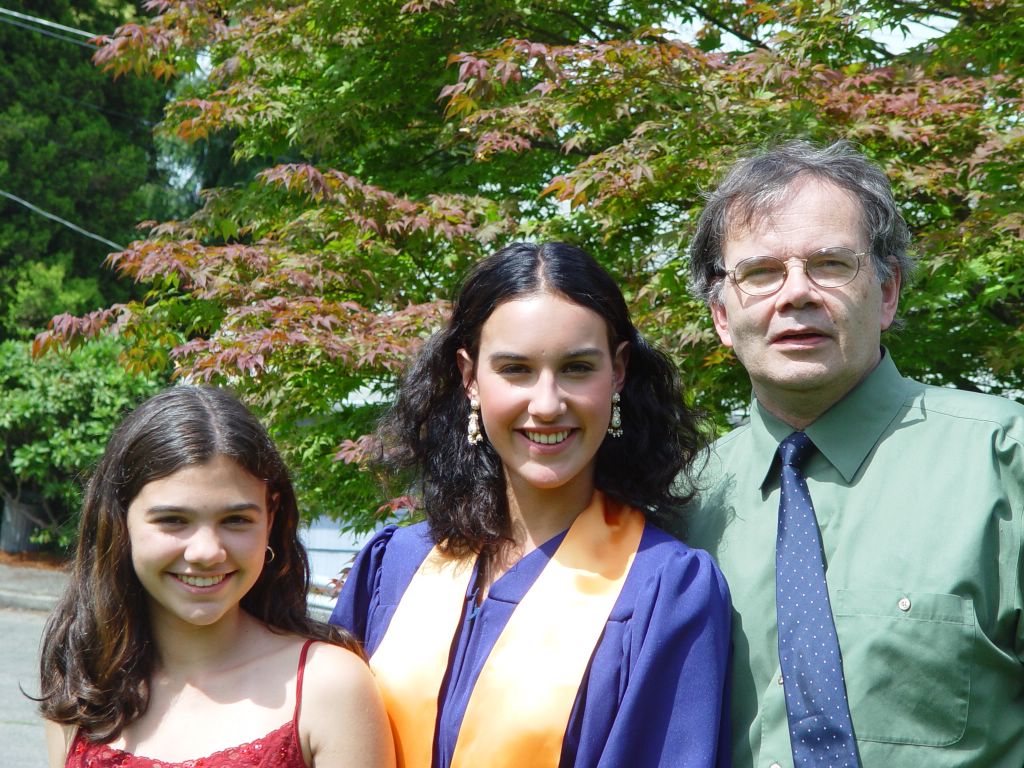
My daughters Anna (middle) and Sarah, and me after the graduation commencement from Seattle Central CC. Anna is 17 and just got her Associate of the Arts degree.

Family Joy

My dad, 94, and my daughters Sarah (middle) and Silja at an assisted care facility in Kouvola, Finland
Subscribe to:
Posts (Atom)