There was an interesting news item during this week, regarding the Sibelius Conductors' Competition in Finland. In a country where more conductors are produced than anywhere, the jury of this international competition decided that none of the finalists were worth the first, second or third prizes. The jury was chaired by well-known Esa-Pekka Salonen, Music Director of the Los Angeles Philharmonic. Read this article in the leading daily, Helsingin Sanomat; it is in English. Perhaps the Finns know more about conducting than others. I cannot picture such a decision taking place in a similar competition in this country.
In my twenties I was living in a city on Finland's West Coast. My first wife, an American, was the concertmaster of the orchestra, while I was in charge of teaching violin, viola and chamber music in the conservatory, also conducting their chamber orchestra. The elderly gentleman, who was the maestro for the Symphony, did his job very professionally. Unfortunately he had been there for too long, and the some of the players were unhappy with the situation. Since in that system there was no danger for the musicians to be fired (they were city employees), they could get away with a lot more than here. The conductor suffered a stroke, and everyone thought that was going to be the end of his story. But the man recovered and returned to work after a long sick leave. To show how miffed they were, the entire horn section went out during a break at an evening rehearsal in the cold winter, and let let the air out of this poor man's car's tires. This was too good a hint and the gentleman retired soon afterwards.
The job was then given to a young conductor, supposedly gifted, who was a member of a conservative party (as I wrote before at some point, in this city the pie was divided this way: the political left had the conservatory). Unfortunately, this man's ego was greater than his talent, and he was involved in the political scene more than in trying to develop his musical skills. My wife, who was a terrific violinist and artist, didn't get along with her new boss very well. At some point, the city's music council decided to fire my ex, because she had, during her own sick leave after an operation, come back to the U.S. to visit her critically ill father. Anything for an excuse; one is supposed to stay put during a sick leave! Soon we left and I took the job as a concertmaster in Malmö, Sweden. Back in Finland, this conductor continued driving his black limousine, but soon it became all too evident he wasn't up to the musical demands of the job and he was ousted by the same council. Today he is the director of a music school in a rather small town, I believe. Such is life. The orchestra's present, longtime concertmaster is a former student of mine, born and raised in that city.
Today, the youngest of my four daughters is officially becoming a teenager. What a great young lady she is! At the same time her 18-year-old sister has been moving her belongings to Bellingham, where she is about to start at the Western Washington University as a junior, majoring in political science and minoring in Latin American studies. Although we'll be seeing her often, as she has her own car and the campus is only about a 90 minute drive from here, I'll miss her terribly. We have a very close relationship and her absence will leave a void in my heart. Of course, to her this is an exciting time, the beginning of a new chapter in life.
Saturday, September 17, 2005
Thursday, September 15, 2005
Hermann Michael remembered 1
This is the obituary in the New York Times:
September 14, 2005
Hermann Michael, Maestro, Dies at 68
By ANNE MIDGETTE
Hermann Michael, a conductor who appeared around the world and was music director of the Phoenix Symphony for seven seasons, died on Sept. 1 at his home in Uffing, Germany. He was 68.
The cause was aplastic anemia, a rare blood disease diagnosed in 1999, the orchestra announced.
In addition to working in Phoenix, Mr. Michael had a special relationship with Seattle, where he appeared nearly every season as a guest with the opera company after making his American debut there in 1984. He led three complete "Ring" cycles in Seattle, and regularly performed with the symphony.
Mr. Michael conducted at the Metropolitan Opera a number of times, leading "Fidelio," "The Flying Dutchman," and "Die Fledermaus." Other guest appearances took him to the Berlin Philharmonic, the London Philharmonic, the Boston Symphony Orchestra, and many other major ensembles in Europe and North America.
Born in Schwäbisch Gmünd, a Bavarian town, in 1937, Mr. Michael studied piano and cello at the Stuttgart conservatory, but had had no formal conducting training when he audited a master class of Herbert von Karajan's in Berlin in 1960. Afterward he announced to Karajan that he could do that, too. Karajan had him come back the next day and conduct the Sibelius Fifth Symphony. Even more surprisingly, he approved of what he heard.
After this experience and a three-week master class with another acclaimed conductor, Hans Swarowsky, Mr. Michael was invited to take part in the first Cantelli Conducting Competition in Italy, which he won. He later served as Karajan's assistant at the Vienna State Opera and undertook some significant guest engagements before becoming director of the Bremen Opera from 1970 to 1978.
His debut in Seattle came at the recommendation of the American baritone Dale Duesing, who sings frequently in Germany and Seattle. Later in his life, Mr. Michael taught conducting at the Munich Musikhochschule, a position he gave up in 2000 because of ill health.
Mr. Michael met his wife, Brigitta, a violinist, when he was 21. She survives him, along with their four children, Ariane, Angela, Ramon and Dunja, and 10 grandchildren.


Hermann Michael remembered 2
 My friend Hermann Michael sent this recommendation to me in May. He wrote it by hand, in spite of his grave illness. You can sense his loving relationship with Seattle musicians in his writing. How we all miss him!
May 10, 05
To whom it may concern,
I would like to let you know how much I appreciate Ilkka Talvi, the former concertmaster of the SSO.
I know Ilkka from numerous occasions as a guest-conductor with the SSO since 1984. Since then I was guest-conducting more than 30 major orchestras in the U.S.A., including the famous big orchestras as the Chicago Symphony, Boston Philadelphia, San Francisco or the MET.
In my personal judgement Ilkka can bear the comparison with the concertmasters of those great orchestras.
Ilkka is a great artist and a wonderful violinist as well. I do remember my first appearance with the SSO in 1984: despite my poor English at that time I felt immediately a musical oneness with him. He understood every gesture and knew immediately how to “translate” it into violinistic terms. Over all these years he demonstrated his ability to lead a Violin-group, to demand the best quality from his collegues and to communicate with them always very friendly, not hurting anyone’s feelings.
He is at ease with every musical style, Symphony and Opera repertoire as well.
Many outstanding performances remain in my memory, with him as a soloist and as the concertmaster of my beloved SSO.
Hermann Michael
Monday, September 12, 2005
Lahti memories
I was 16 and living by myself when the Lahti orchestra in Finland asked me to come along as a sub to their short tour to their sister city in Sweden, Västerås. I agreed and had to buy my first set of tails. I knew the Lahti orchestra well, having played with them as a soloist at 13. Many of their musicians had come to help out in my dad’s orchestra in Kuusankoski and I had befriended them.
Finnish musicians like to drink (no wonder I always felt somewhat like an outsider there) and the orchestra had insisted that the trip be made by one of the numerous car ferries that take about 8 hours to cross from Turku to Stockholm. “Ferry” is a misnomer as these magnificent floating monsters are like the fanciest cruise ships, Some can be ten stories high or even more. Cars are kept out of sight in the bowels of the mammoth ships. Main thing is that everyone has fun.
So, my colleagues immediately started drinking (alcohol used to be much cheaper then, before the EU) and since I looked much beyond my years, I had no trouble joining them. From early on I knew my limits and never enjoyed losing control, so I was careful. The orchestra had hired a visiting principal cellist who really had a weakness for liquor. After the boat trip we had to bus for an hour. The mayor and everyone important were meeting us. The first bus door opened and the guest principal cellist rolled out, absolutely plastered, to the mayor’s feet, not being able to move an inch, and threw up. I was quite embarrassed but everyone seemed to think this was normal.
The concerts went surprisingly well. The conductor’s violinist son was the soloist (nepotism is everywhere), but he did a respectable job with his Tchaikovsky. Needless to say, the cellist did not play a note but was fine by the time the return voyage started, ready for more fun.
Today this orchestra is a hot item and plays in a fabulous wooden hall. Osmo Vänskä used to be their conductor for many years, before leaving for Minneapolis. The group has recorded an incredible number of compact discs, mainly for the BIS label. After moving overseas I’ve returned there once, to play the Tchaikovsky concerto with them.
Eye Candy
 There was an interesting article in Sunday’s New York Times, about music and sex appeal, and an excellent link (beautyinmusic.com) which you should check. Sex has always sold and today such is the case more than ever. If you check some of the pictures available via the link, you’ll soon see that glamorous pictures of these female artists, often with plenty of skin showing, are more important than their musical and artistic skills. It is a sad state of affairs, at least in my opinion. Where would great violinists who were not known for their skin deep beauty, such as Ginette Neveu or Ida Haendel, fit in today’s meat market world?

As I know many of these babes pictured, it amazes me what magic photographers can produce. By showing a bit more bare skin, a viewer’s attention is drawn away from an ordinary face, and a sexy eye candy image is created. Even not-so-attractive features can be transformed to something else with lighting tricks and using filtering effects. How about having mug shots of these beauties taken first thing in the morning, before the thick layers of make-up and outfits suited for an expensive escort service?
Today’s mail brought an envelope addressed to my wife. It was a request for a donation, one of many every day, but the text on the outside caught our attention:
BECAUSE IT’S A VERY JEWISH THING TO GIVE SOMEONE A LIVELIHOOD.
Hmmm…
In pictures: Aniela Perry, cello (left), Linda Brava, violin
Nine-One-One
Yesterday marked the fourth anniversary of 9/11 attacks on the World Trade Center and the Pentagon. Interesting how one country’s tragedy was cause for celebration in other parts of the world. Many fundamentalist and militant Muslims felt joy and pride for their brothers managing to stick their thumbs up the nose their archenemy, Uncle Sam. Within hours the plans to invade Iraq were in full motion. Of course, history has shown already that instead of curbing terrorism, this invasion and occupation created a whole new breed of it. Interestingly, this was not the only 9/11 with this kind of a scenario. In 1973 Chile’s democratically-elected president Salvador Allende was overthrown and assassinated in a military coup, supported by our very own CIA, code named “Project FUBELT”. General Pinochet and his supporters celebrated, as did many in this country, and yet much of the free world was stunned and wept. Countless number of people were tortured, died or simply vanished as a result. I’m sure there are other similar celebrations that are mourned by equally many.
9-1-1 is also a quick way to send the police to someone’s door. We had a disturbed resident a couple blocks up who decided that either my wife or her students’ parents were driving too fast past his house. The strange part of the story is that the street is very narrow at that point, and it is very difficult to see down the hill, so nobody wanting to stay out of harm’s way would drive faster than 10-15 mph. I guess that by sending the policemen here made my wife seem a criminal in his view. He soon moved away, to the relief of everyone in the neighborhood.
Breaking news just told about the resignation of Mike Brown, the head of FEMA. Duh. Although our President initially praised him for handling the hurricane aftermath, the fiasco grew too big to sweep under a rug. Perhaps Mr. Brown can return to the area to head a Seahorse Association, as his expertise is better with horses than people.
Just a couple days back HBO showed a terrific “Real Time with Bill Maher.” We need more people who can speak their mind, and the truth, about the way our country and world is headed. This show started with a joke about a certain former White House intern from the Clinton era becoming a psychotherapist; so that she can blow peoples’ minds, and went on to attack the intolerable handling of Katrina’s aftermath, addressing our head of state directly in the famous “New Rules” section. I wish I could speak my mind like that, or even a fraction of it, without threats of lawsuits. I am happy that Mr. Maher is allowed to exercise his first amendment rights: we all need to hear something different from the censored picture of events even CNN gives us these days.
Friday, September 02, 2005
Ratlantis
Granted, they are black and poor, except for some tourists that were left behind or patients in hospitals, but that is no reason to treat these people like rodents. Footage from New Orleans is worse than if Port-au-Prince in Haiti had been hit by a tidal wave. The world is following the worsening disaster with amazement. How can the richest country be so inept with helping its own citizens? If America didn’t already lose its face in Iraq, it surely is doing so now. Do we not care about these people, most of whom were too poor to get out on their own? They had little to start with: now they have nothing. Granted, these people are not likely to be supporters of the governing party or even registered voters, but they are as much human beings as you and I. This wouldn’t have happened in West Palm Beach or in Orange County. May I suggest a mandatory 4-day stay in the Superdome for all those members of our government in charge of aid? And don’t clean the toilets beforehand or remove the dead left sitting in the spectator seats.
Ratlantis is truly a lost city under water. It is ironic that we have known for a long time how vulnerable that place would be: two different studies, just seven years ago or so, suggested improvements to protect the city from a disaster like this. Of course, nothing got done as a result. We refused to take part in the Kyoto Agreement and help do our part in curbing the warming climate. We should therefore expect more frequent catastrophic storms and rising seas, both extremely dangerous to low-lying areas, not to mention places below sea level.
What upsets me the most is that people seem to be worried about the Mississippi Delta area for the same reason the war in Iraq bothers them now all of a sudden: sharply higher fuel prices. Is driving to work in a big SUV really more important than human lives? How about improving public transport and getting used to the idea of utilizing its services?
And bring back the National Guard from Iraq! They were never meant to be used to invade a foreign country, but to provide critical help in domestic tragedies such as this. I’m sure they would much rather be saving lives than taking them, or losing their own.
When do you think will be the next time a symphony concert will take place in Ratlantis?
Thursday, September 01, 2005
Hermann Michael In Memoriam

I just received word that my dear friend and Seattle’s favorite musical guest for 20 years, Hermann Michael, passed away this morning, after a long illness, at his home outside of Munich, Germany.
Hermann first came to Seattle to conduct a Wagner opera production in 1984, and was a beloved regular guest conductor for both the opera and the symphony since then. As this town was the site of his first American appearance, it always held a special place in his heart, and he had a large number of loyal friends and and admirers here. He was one of those rare maestros to whom music was everything, not his own career and fame. When I think of him, I instantly see a smiling face. He radiated love for music and for his musicians, and always managed to make everyone do their best by his positive and inspiring approach. I had the fortune of playing as soloist with him twice, with the Tchaikovsky Violin Concerto and also the Brahms Double. We had a perfect musical understanding and could have performed even without rehearsing. Playing the ‘Ring’ cycles with him made those endless hours go by quickly and painlessly.
Like many others, I will miss this incredible musician and human being terribly. I had last spoken with him in May over the phone and had just sent him a letter which he hopefully got to read. I am happy, however, that he is no longer suffering. Death is part of life after all. We all wish he could have been with us much longer, but his time had come. My heart goes out to his wife and family, and other beloved ones.
Friday, August 26, 2005
Summer reading
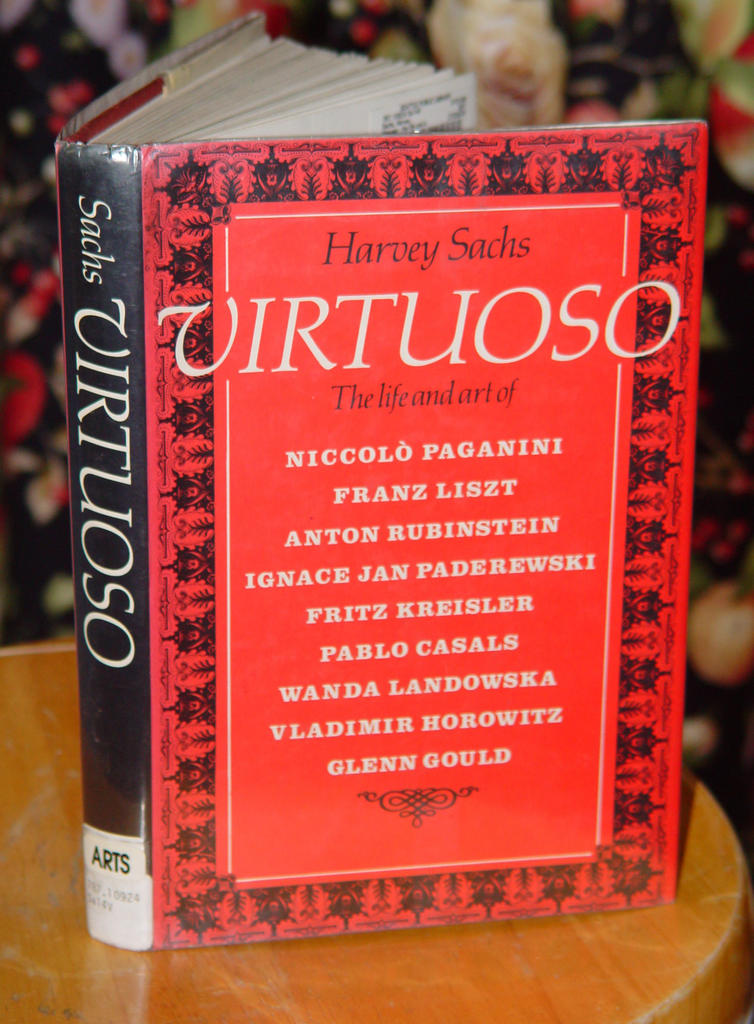
In addition to a rather large number of books on music in our bookcases, my wife brings other ones home from the Seattle Library system. Recently I have read ‘Music and the line of most resistance’, by Artur Schnabel, and ‘Virtuoso’, by Harvey Sachs. They were written 40 years apart, in 1942 and -82, respectively.
Old books often open a window to a different era and offer the reader an opportunity to see life from a very different perspective from today. In music, some problems have remained the same: Schnabel writes about music critics and art journalism at length and states: ‘Great men are as rare among the critics as they are among the musicians or any other group, but the consequences of not being great are not the same for critics as they are for musicians who appear in public. Only the musicians are publicly criticized.’ The writer laments the disappearance of amateurs which he, to a point, blames on the radio and the phonograph. ‘It follows that the amateur, as I define the term, always dwells on a plane higher than that of a professional who never produces, and is never keen to produce, what may be classified as art. Not every musician is an artist.’ Schnabel has other refreshing opinions as well: ‘To correct the misconception concerning “virtuosity,” which (I must emphasize once more) must also be completely mastered for the performance of inwardly originated music, although it is generally related to the external (which is about all there is to the other species), Walter J. Turner, the English poet, has suggested giving to the the so-called “virtuoso” a new name. The name is “trashoso”—which would precisely express what is nowadays expected from the virtuoso.’
The other book has short biographies with comments of nine famous instrumentalists, from Niccolò Paganini to Glenn Gould. Right now I’ll stick to ‘The life and art of Fritz Kreisler’. In 13 pages (plus a few for pictures) Sachs manages to spin a fascinating tale of probably the greatest artist violin playing has ever seen. Father Kreisler was the family physician of Sigmund Freud, who couldn’t quite understand why young Fritz was taken by his mother, at the age of 10, to Paris to study. Massart, himself a pupil of Kreutzer, wrote that although he had been ‘the teacher of Wieniawski and many others…little Fritz will be the greatest of them all.’ Another interesting detail is that Kreisler auditioned for a position in the Vienna Hofoper Orchestra (also known as the Vienna Philharmonic) but was not accepted. That tells you something about the fairness of auditions even back then! The author correctly points out that Kreisler’s name should not be used to symbolize sentimentality or schmalz. ‘The recordings he made are evidence enough that such notions are largely groundless.’
A well-known fact is that Fritz never liked to practice; he considered it a bad habit. A violinist friend of my father’s occupied a room next to the master’s during a mid-1930 tour to Finland. For three days the poor man had his ear glued to the wall, as he was determined to find out the secret of Kreisler’s artistry, from the way he practiced. Only on the third day, just before the concert, did the maestro take out his violin: he tuned it and put it back in the case. My dad used to tell me how upset this friend was; on a tight student budget and during the depression years, that certainly wasn’t money well spent.
Monday, August 22, 2005
Finns in the News
My countrymen have shown up in the news during the past week. Finland’s former president Matti Ahtisaari brokered a truce agreement between Indonesia and Free Aceh movement (GAM) which was signed August 15th. Aceh was the area hardest hit by the December tsunami of last year, with 130,000 casualties. GAM has been fighting for independence from Indonesia for almost 30 years. The new agreement calls for more autonomy but leaves the area as part of that nation. Another Finn is there overseeing the collecting of firearms and other weapons. Sometimes it takes a great tragedy for people to understand that peace is the best and only solution.
Now to sports: Helsinki hosted the track and field World Championships this month. Mother Nature wasn’t in her most co-operative mood and many events had to be postponed due to rain and storms. At the same time an American made helicopter from Tallinn, Estonia, crashed into the Gulf of Finland, killing all 14 abroad, during what was supposed to be a regular commercial 15-minute hop to Helsinki. Just yesterday, a Finnish Formula 1 driver Kimi Räikkönen won the inaugural Turkish Grand Prix. I watched him win the Canadian one in June on Finnish television. While he may not be a rocket scientist, he sure knows how to drive and race.
Today’s New York Times has one of the best reviews the Mostly Mozart Festival has ever received. The resident orchestra was conducted by Minnesota Orchestra’s Osmo Vänskä, whom I remember as a clarinetist and starting Kapellmeister in Finland 30 years ago. Obviously something remarkable took place in Avery Fisher hall this past weekend, as the orchestra used to be known more or less as a pick-up group. ‘Perhaps the most interesting aspect of the growing fascination with Mr. Vanska is that it is based entirely on his musicianship. Now in his early 50's, and given to energetic podium gestures that are often graceful though occasionally slightly clunky, he is not a picture of conductorial glamour. What Mr. Vanska does on the podium, though, is extraordinary, and on Saturday evening he made Mostly Mozart's resident freelance band sound like a world-class ensemble.’ Wow. I’m happy for the orchestra and Mr. Vänskä. Perhaps all his experience with rather small Finnish orchestras and in Lahti in particular, have given him a perfect know-how as to what a classical orchestra needs to excel.
At some later time I’ll write about a comical experience I had touring with the Lahti orchestra when I was just 16.
Sunday, August 14, 2005
Excuse me
When I first heard Michael Rabin perform during the Sibelius Week in Helsinki, prior to his concerto the festival's manager came out on stage. An announcement was made: Mr. Rabin's sister has suddenly died that morning but the soloist would nonetheless go ahead with his performance. All the older ladies in the audience took out their handkerchiefs and cried. I, too, was touched. A couple years later I heard Rabin again, this time in a smaller town in this country. The same story was repeated and I smelled a rat. Later I learned that there was no sister to start with.
Although it is not common for instrumentalists to make excuses, that does happen. A violinist showed up with a bandaged finger, very noticeable to the audience all the way to the last seat on the top balcony, and ended up with reviews which talked about her ‘injury’ rather than playing. Another one insisted on sitting on a stool, as a sore back is not as visible as a taped digit. What about orchestral players? When was the last time you heard an announcement that the principal oboe was going to play the evening concert, in spite of his hemorrhoids, or something to that effect? I do remember a principal string player being wheeled to the stage and off, even after the injury had healed. Once offstage she would hop off the wheelchair and walk normally.
Singers, in opera particularly, are another story. Of course the vocal cords are unpredictable, but that doesn’t account to the fact that during the course of an opera production the audience gets told time after time that Ms. Prima Donna or Mr. Helden Tenor are suffering from this and that, thus their voices are perhaps not in top shape but yet they insist on singing. Seldom is this evident in the performance, however, but conveniently this puts the singers in a taboo category: a critic or a mere mortal listener cannot possibly be critical of faulty intonation or anything else since the performer has such a ‘valid’ excuse. What would happen if listeners would demand their money back when performers admitted they were not doing their best? That would be fair after all, wouldn’t it? Or at least partial refund should take place. I bet those announcements before the start of a show or an act would be far less frequent.
Perhaps concerts, opera and ballet performances would become more interesting if there was a program insert for each show, indicating which performers were not in top shape, and for what reason. We could have a color coded or a point system for different levels of threat to a perfect performance. At the end of the year the points would be tallied and the averages published. A musician, dancer or even a conductor could get a bonus based on this. Question is: how much does a toothache affect one’s ability? What about a chronic condition, such as obesity, or just being seriously unhappy with one’s colleagues, not to mention having something stuck up the rear end?
Wednesday, August 10, 2005
The Better Half
This post is by my wife Marjorie -
Today, while walking and listening to my husband's recording of "Russian Easter Overture" I came home insisting to share an entry on Ilkka's blog. I think a wife deserves that much, don't you? We have lived through a traumatic and sad year but have grown all the wiser and closer for having survived our crisis together.
My first encounter with Ilkka Talvi took place in a chamber orchestra in Los Angeles. I will never forget how mystified and intrigued I became while listening to a violin solo that he performed during a concert. Who was this quiet, humble man that sounded like a beautiful voice from the past? Since I had been brought up on and practically fed Heifetz and Kreisler recordings in my youth, I immediately recognized that this dark, Finnish violinist played with a sound reminiscent of a bygone era. I wanted to know him...KNOW him. I pathetically inched my way close to him to say, "Gee, you play so beautifully". His reaction, ever so typical of my Ilkka was, "So what?" He has always failed to take compliments well and I doubt will ever be at ease with flattery.
So, we did get to know one another well, and in the process have created a life in music and two fantastic daughters. As trying as life can be, and as unforgiving, I feel it an honor to share my life with one who is so remarkable, yet humble. Ilkka, a shy, sensitive man, has not always received the recognition or acknowledgement that he's justly deserved. I am in part writing this for all those who care to know, that I believe there are a few among us who are unsung heroes, my husband included. They unobtrusively perform their tasks and duties so well, yet with such humility, that they go unnoticed and are not applauded for their rare talents and contributions.
I would like to say "thank you" to Ilkka for being a magnificent artist, husband, father and friend. He used to rush home after concerts in order to say goodnight to our girls, and they've flourished from all that love and devotion.
Thank you Ilkka, for sharing your rich, worldly experiences with your family and students, and congratulations for unearthing another marvelous talent in writing, especially in a language that only became yours in your adult years. .
No conscience
Sociopaths are people without conscience. Not only that, but they are unable to feel and express love and compassion of any kind. In many cases, our society idolizes them as they seem to be the successful ones, becoming shrewd CEOs, successful politicians and other leaders. They can also become remorseless criminals, even seemingly charming serial killers (Ted Bundy) and such. In the army they make the best soldiers as they will never for a split second question orders to shoot to kill, as destroying a life doesn’t bother them in any way. In non-military world the same lack of guilt makes them seem like ideal people to lead businesses and other organizations, to function as lawyers and in many other professions, as feelings don’t get in their way. Firing one person or fifteen thousand people is equally easy for them. A destroyed life or career is of no concern to them.
Last week, as I was having my usual trouble with my shoulders and neck and couldn’t do much practicing, I read an interesting book on this subject. 'The Sociopath Next Door' was written by a Harvard psychologist, Martha Stout. Many of the case histories reminded me of people from my past and present life, some family members included. Ms. Stout claims that about 4 % of the U.S. population consists of sociopaths; in some other societies, such as Taiwan, the frequency is much lower. That percentage is frightening as it means there are about 11 million of these monsters in the United States, five in a small business or organization of 125. The purpose of the book is to teach a reader to recognize a sociopath and protect oneself from becoming a victim. The book has 13 rules for dealing with these people in everyday life, a most interesting and useful chapter. It also tells in detail how the brain function of a sociopath differs from normal people with a conscience, as a result of fascinating research done all over the world.
Although the book is not intended to be a literary masterpiece, it offers a lot of important information, and makes a normal person aware of this subspieces of the human race. For instance, how many of us would suspect that a sociopath can pretend to have feelings: tears are easier for them to produce than for me and you, even though they are meaningless and meant to trick us. A sociopath may end up marrying but will always think of his/her spouse and children as possessions, like trophies, as love cannot be part of his or her life.
Since early on I have had a different theory on this subject. As I believe in reincarnation, I don't think there are enough human souls to go around, especially today with the rapidly expanding population. Perhaps the person next to me got his from a hyena, a shark or even an insect; it wouldn't surprise me a bit. Not so nice to meet you, Mr. Portuguese Man-of-War.
Monday, August 01, 2005
Quick fix
As I had the pleasure of playing as concertmaster of the Mostly Mozart Festival Orchestra for three summers, it is only natural that I follow closely their situation at present. They seem to be in fine shape today; a far cry from the strike and canceled season just a couple years ago that almost killed the orchestra.
The Lincoln Center’s Philharmonic Hall opened in 1962 and was initially praised. Its acoustical problems became evident soon, however, and by 1976 it had undergone a major acoustical reconstruction, with Cyril Harris as the acoustician. By this time the building had already been renamed Avery Fisher, after a major benefactor. Midsummer Serenades started in 1966, to be called Mostly Mozart in 1972. The series proved to be a big hit, perhaps partially because people could enjoy an air-conditioned space, with easy-to-listen music, in the middle of a hot and humid Manhattan summer.
Happiness with the new hall design didn’t last all that long and for many years the primary occupant, New York Philharmonic, had expressed dissatisfaction with being stuck there. A deal was almost made which would have returned them to Carnegie Hall, but that fell through. This summer the Mostly Mozart Festival has moved the stage into the hall, as a rather expensive experiment. There are now seats behind the orchestra, right where musicians used to sit. Initial reactions from audience members, musicians and the press have been somewhat mixed. Just about everyone agrees there is more intimacy, which is not surprising since distance between the new stage and the listeners is shorter. Some prefer the new sound, others complain that the sound of the higher strings is too muted. Many simply feel that anything new and different is a step forward.
Perhaps a hall would have to be built from the ground up, to fully benefit from this setup. After all, this experiment is intended to be a quick fix. Sometimes one doesn’t work, other times it does, but seldom as well as in this story a friend forwarded to me:
Doctor Bloom, who was known for miraculous cures for arthritis, had a waiting room full of people when a little old lady, completely bent in half, shuffled in slowly, leaning on her cane.
When her turn came, she went into the doctor's office, and, amazingly, merged within half an hour walking completely erect with her head held high. A woman in the waiting room who had seen all this walked up to the little old lady and said, “It's a miracle! You walked in bent in half and now you're walking erect. What did that doctor do?”
She answered, “Miracle, shmiracle ~ he gave me a longer cane.”
Give or take
Philanthropists often want to be seen as almost superhuman heroes of the arts, sciences and education. Recent times have not been very kind to them, at least as patrons of the arts. First, there was the curious and messy Herbert Axelrod affair, with his instrument collection sold ‘far below market value’ to the New Jersey Symphony. Then a long time opera benefactor Alberto Vilar couldn’t fulfill his pledges and ended up defrauding an investment client, to keep up his own image. A tragic third episode occurred last week when Arthur Zankel, of the Carnegie Hall fame, committed suicide.
What would drive a philanthropist to do such things? With all that excess wealth one would think these people have everything money can buy. Well, as I have noted before, happiness is not for sale. In Axelrod’s case, there was greed behind it all: by ‘helping’ an arts organization he ended helping himself financially much more. Thus he became a common crook, a criminal that escaped the country and was caught by Interpol. Vilar was probably more of a genuine patron, but couldn’t face the fact that his diminished wealth wasn’t enough to enable him to keep his promises and therefore he was stuck in a potentially humiliating situation. In his case, turning to crime made matters only worse.
Of the three, my heart goes out only to Mr. Zankel, who by all accounts was as decent a person as a financier can be, but who suffered from severe depression. Any of us, who has known a victim of this illness, is well aware of how devastating it can be. Sometimes depression can be treated, at least to a degree, but not always. May this man’s soul rest in peace.
Wouldn’t it be nice if more donors remained anonymous? There is a lot of joy in giving, without one’s name being broadcast to the public. Must we be so vain that we cannot feel happy about sharing our wealth and good luck without seeing our names in print, whether in a program or on a wall of a building? After all, we are supposed to be giving, sharing and helping, not buying advertisement space for our inflated egos.
Subscribe to:
Posts (Atom)